
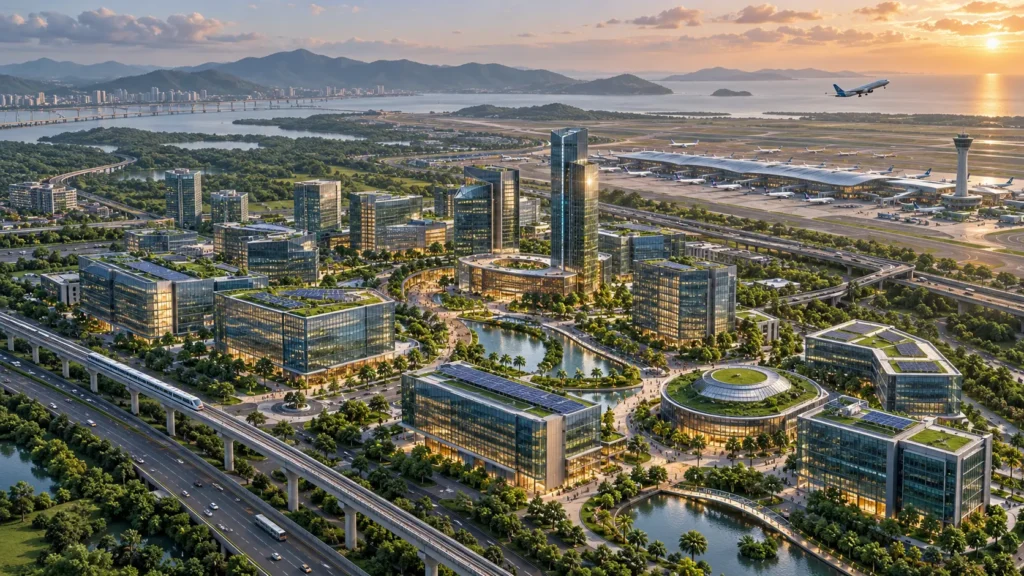

India is rapidly remapping its tech manufacturing boundaries. Forget the old IT parks crammed into saturated urban centers.. the current obsession is huge, integrated ecosystems built from scratch.
Government officials and corporate giants spent most of early 2026 making serious bets on deep-tech infrastructure, creating a scenario where having the details of Tata’s $11B Innovation City near Navi Mumbai airport becomes essential for anyone tracking the global tech race.
At the World Economic Forum in Davos this January, Maharashtra Chief Minister Devendra Fadnavis made it official. Tata Sons is pouring $11 billion- roughly ₹91,000 crore- into a sprawling new hub right beside the upcoming aviation gateway.
This is a calculated move to anchor a big digital capability center right as global demand for artificial intelligence and cloud computing hits unprecedented levels.
Building a tech hub in 2026 requires absurd amounts of physical space and flawless global connectivity. The decision to drop a large plug-and-play research district directly next to the new Navi Mumbai International Airport solves both problems instantly.
For years, South Mumbai’s commercial districts simply choked under their own congestion, making large-scale corporate expansion physically impossible.
By shifting focus to the Raigad-Pen growth centre, Tata gets the land scale needed to build entirely new ecosystems from the ground up. The timing aligns perfectly with the Mumbai Trans Harbour Link tearing down commute times.
It turns an isolated region into a highly accessible economic zone. This specific location gives the Innovation City immediate access to global transit routes, meaning international talent and hardware can fly straight into a dedicated tech corridor without battling hours of city traffic.
Technology And AI Inside The Tata Innovation City Masterplan
We know exactly where that capital injection is going. The masterplan heavily targets the physical infrastructure necessary to run modern artificial intelligence models, focusing heavily on semiconductor design and high-capacity data centers.
Tata is explicitly structuring the Innovation City to lure researchers and deep-tech startups who need serious computing power ready on day one.
Running thousands of advanced servers requires ridiculous amounts of electricity, which brings us to the sustainability angle discussed heavily at Davos.
Maharashtra state officials are already in early talks to deploy small modular reactors to handle these aggressive energy requirements.
If successful, nuclear-powered data centers will turn this project into one of the most resilient tech hubs on the planet, completely insulated from standard grid failures.
Economic Scale Of The Tata Innovation City Project
The sheer volume of money moving through this project completely shifts how global markets view Indian infrastructure.
Maharashtra is strongly pushing to establish a Trillion dollar subnational economy, and positioning this specific hub to attract heavyweights like Microsoft, Amazon & Alphabet is a core part of that strategy.
Global demand for Data center capacity is expected to triple. By funding the Innovation City out of the gate, Tata essentially guarantees that a major chunk of that future investment lands directly in Maharashtra rather than fleeing to competing Tech corridors in Southeast Asia.
This significant Capital commitment moves the region far beyond a traditional Real estate play.. transforming it into a heavyweight deep-tech competitor fighting for a permanent spot on the World stage.