
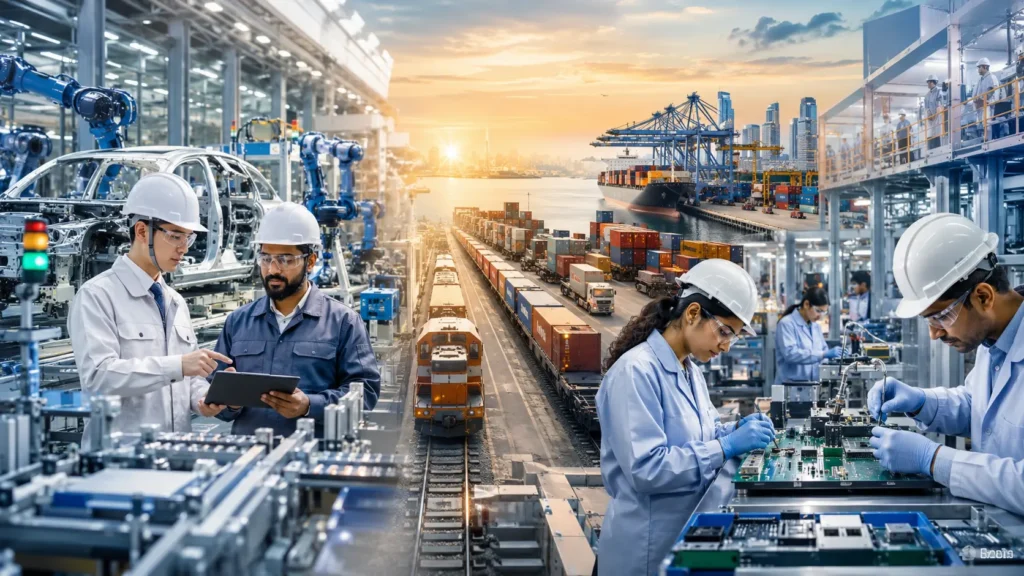

Global supply chains do not just move.. they fracture and rebuild where the ground is stable. Right now, we are watching one of the most aggressive capital migrations in modern economic history.
This article breaks down the exact geopolitical triggers and economic realities explaining the motives behind the Japan’s deliberate choice to transform India into its primary industrial epicenter.
Over the last few years, Japan realized its overreliance on legacy authoritarian markets was a strategic liability.
By heavily leaning towards India, Tokyo is aggressively securing its future, actively turning the democratic nation into a sprawling manufacturing hub designed to supply the entire globe.
How India Replaced China To Become The Ultimate Manufacturing Hub For Japan
The old “China Plus One” corporate strategy is officially dead; it has rapidly transformed into an outright economic exodus.
By 2026, Japanese foreign direct investment in Chinese markets has collapsed by roughly 70 percent over four brief years. Corporate Tokyo is ruthlessly cutting its losses.
Instead of arbitrarily scattering investments globally across Southeast Asia, Japan zeroed in on India. State leaders recently doubled down on their bilateral commitment, cementing a staggering ¥10 trillion- approximately $68 billion- private investment target mapped out over the next decade.
The ultimate objective is entirely straightforward. Planners want to strip away supply chain vulnerabilities by bankrolling a highly dependable manufacturing hub right in South Asia.
Japanese capital is actively abandoning historically volatile zones for predictable, long-term industrial growth.
Semiconductors And Autos Accelerate The Japan And India Manufacturing Hub Vision
State-level pledges are mostly useless without aggressive corporate execution, but the hard currency is actually hitting the ground today.
Legacy automotive giants are currently injecting billions of dollars to expand domestic mobility ecosystems and localized supply lines.
But the real undisputed anchor of this new partnership is high-tech silicon. The Japanese electronics powerhouse Renesas is now deeply involved in a massive semiconductor assembly plant located in Sanand, Gujarat.
Concurrently, Tata Electronics is rapidly scaling its Jagiroad, Assam facility, heavily targeting commercial semiconductor packaging operations by late 2026 with critical foreign technological integration.
This dual-pronged financial attack in next-generation vehicles and microchips definitively cements India as an irreplaceable manufacturing hub for Japan.
Corporate leaders are physically building the foundational infrastructure to control the next decade of advanced technology, moving far beyond simply assembling cheap consumer goods.
Policy Shifts Empowering Japan To Build A Futuristic Manufacturing Hub In India
Institutional capital always needs a smooth runway, and heavy bureaucratic friction previously killed major cross-border industrial deals. That restrictive environment is changing rapidly.
Recently, the Japanese Foreign Ministry established a specialized administrative center explicitly designed to push direct foreign investments straight into India.
This specialized cell actively helps huge corporations navigate incredibly complex state-level regulations and regional tax systems. This institutional backing perfectly aligns with New Delhi’s domestic Production Linked Incentive schemes, which have successfully propelled the nation entirely up the global industrial ladder.
By actively removing outdated red tape, Japan can seamlessly integrate its advanced engineering capabilities with an incredible local workforce scale.
Building a massive, high-tech manufacturing hub in India is no longer some abstract bureaucratic dream. It is an active, fully funded reality that is permanently rewriting the global economic order.