
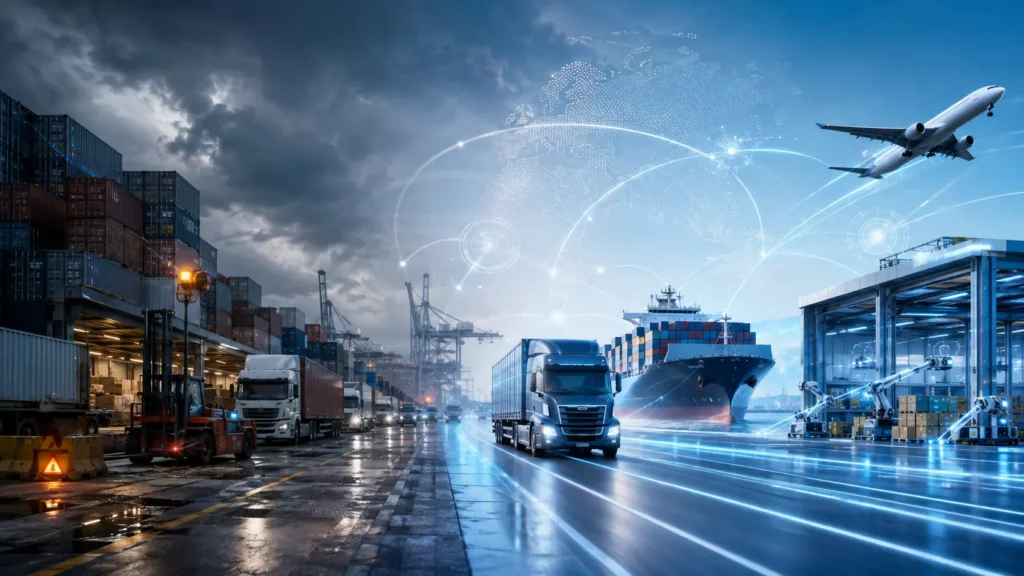

It is 2 AM. A Logistics manager is staring at a fixed spreadsheet, trying to figure out why critical Semiconductors have been sitting dead in a Mediterranean railyard for three weeks.
This is the raw reality of relying on twelve-hour-old data. The old “just-in-time” model is completely dead. Right now, we are finally watching the industry scrape together the capital to genuinely abandon its reactive habits and build something proactive.
Witnessing exactly how these big Supply chains are evolving today is the only thing keeping Global trade from outright collapsing.
We cannot fix a bottleneck we cannot see. In 2026, waiting for a Geopolitical crisis or a sudden demand spike before picking up phone is Financial suicide.
Why Reactive Global Supply Chains Are Dead
Trashing the old playbook was long overdue. For decades, supply chains ran on blind faith and historical guesses, making them inherently reactive.
A container ship gets stuck or a factory floods, and thousands of companies scramble for backup vendors. That cycle is entirely over. In 2026, market realities demand a strictly proactive approach.
Gartner data confirms that relying on single-source suppliers and lean inventories actually created incredibly fragile networks.
Companies are permanently abandoning the outdated efficiency model for extreme adaptability. Sourcing is actively fragmenting into multi-polar trade networks. We are seeing massive spikes in South-South trade and Mediterranean nearshoring.
Data silos that forced companies to plan in monthly quarters are being replaced by minute-by-minute continuous forecasting. You cannot operate logistics on assumptions of global stability anymore. Stability is the rare exception. Chaos is the baseline.
Shifting Supply Chains From Reactive Guesswork To Proactive AI
The technological jump from reactive panic to proactive intelligence completely rewrites how supply chains operate. We are not talking about basic data entry. In 2026, the new standard is agentic AI platforms. Autonomous systems do not just flag a problem. They fix it.
Gartner predicts that by 2031, Sixty percent of all Logistics disruptions will be resolved without human intervention. We are seeing the foundation of this right now.
Instead of a Procurement manager doing periodic manual Audits, domain specific AI bots continuously monitor the Global financial health, Weather patterns & labor strikes of backup suppliers.
If a primary factory in Southeast Asia shows early signs of slowing down, the AI autonomously secures freight capacity and routes orders to secondary facilities in Mexico or Morocco before a human even logs on. It is a ruthless, highly efficient elimination of manual handoffs.
Evolving Supply Chains Beyond Reactive Logistics To Proactive Resilience
AI is brilliant but physical goods still have to move across Oceans and highways. You can build the most proactive digital model on earth, but if your physical supply chains remain strictly reactive, you lose. The physical infrastructure is finally catching up to the software.
Current 2026 barometers indicate a big change away from Linear pipelines toward Circular regional economies. Nearshoring is no longer a political buzzword.. it is a strict mathematical necessity to bypass Global bottlenecks.
Companies are drastically cutting transit times by clustering production centers closer to consumers. Recent models prove that coupling this localized physical footprint with continuous predictive planning cuts logistics delays by nearly forty percent.
Efficiency used to mean running Operations so lean that one delayed truck halted an entire Assembly line. Today true resilience means building in buffers & treating disruptions as guaranteed daily events rather than rare catastrophes.