

Picture a US fast-food brand trying to ship frozen food to a French franchise during a major European port strike. It is a total logistical bloodbath. Shipping costs wipe out your margins before the grills even turn on. The reality? You do not ship the food. You buy the local farm and build the restaurant right there.
If you want to figure out exactly how horizontal FDI helps companies grow across borders without bleeding cash, just look at the firms aggressively cloning their operations in a foreign backyard.
Why Horizontal FDI Beats Basic Exporting Every Time
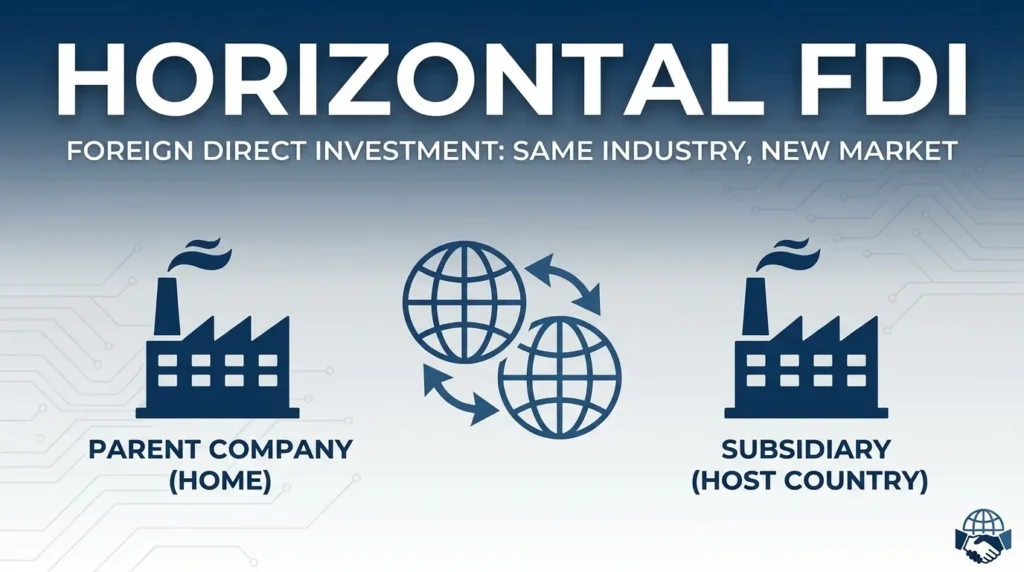
Horizontal Foreign Direct Investment is just corporate cloning. A company takes its exact business model and drops it into a new country. Exporting means dealing with sudden tariffs, endless customs holds, and wildly unpredictable supply chains.
But by replicating yourself locally, you bypass all of that friction. A perfect carbon copy. Just in a different timezone. According to early 2026 IMF data, high-intensity tariffs are forcing companies to abandon their old export models entirely.
They substitute physical exports with local market-focused investments. You simply make the product where the customer actually lives.
The Hidden Economics Behind Horizontal FDI and Company Growth
Companies do not drop billions on foreign factories just for the publicity. They do it because their home markets are completely saturated. Building a massive physical footprint abroad is financially violent in the short term. But it effectively neutralizes long-term trade barriers.
Tech companies always thought they could cheat this system. They tried to avoid physical assets, assuming software scales infinitely across borders without friction.
Foreign governments started demanding local data centers for security compliance. It turns out physical infrastructure still rules the global economy.
Bypassing 2026 Trade Barriers to Grow Across Borders
Recent tariff hikes did not cause a generic investment boom. They triggered highly targeted horizontal expansions. If you want to sell a car or an electronic component in India in 2026, you build it in India. Period.
Because the Indian government’s DPIIT recently expedited approval timelines to just 60 days for priority manufacturing to feed this exact frenzy. The country already smashed past the $1.07 trillion mark in cumulative foreign investment.
Companies are pouring this money in specifically to capture that massive domestic consumer base without paying ridiculous import penalties.
The Messy Reality of Expansion for Multinational Companies
This strategy is incredibly messy in practice. Academic papers love to gloss over the actual damage, like the rapid cannibalization of home-country jobs. Running identical companies under completely different legal systems is a compliance nightmare.
Sometimes foreign corporations panic, pull out, and leave a massive economic crater behind them. Look at the billions that portfolio investors randomly pull out of emerging markets when the political winds change.
Horizontal operations face severe existential risks the second a host country’s currency inevitably tanks.
Where Capital to Grow Across Borders Actually Lands
Most of this money does not travel in a straight line. Capital flows shift through specific intermediate hubs. Mauritius and Singapore act as massive funnels for corporate investments, driven entirely by aggressive tax treaties rather than actual geography.
Companies park the cash there before building the duplicate factory somewhere else. The real question is whether this cloning model is actually a sustainable way to do business, or just an insanely expensive temporary fix for fractured global trade.