
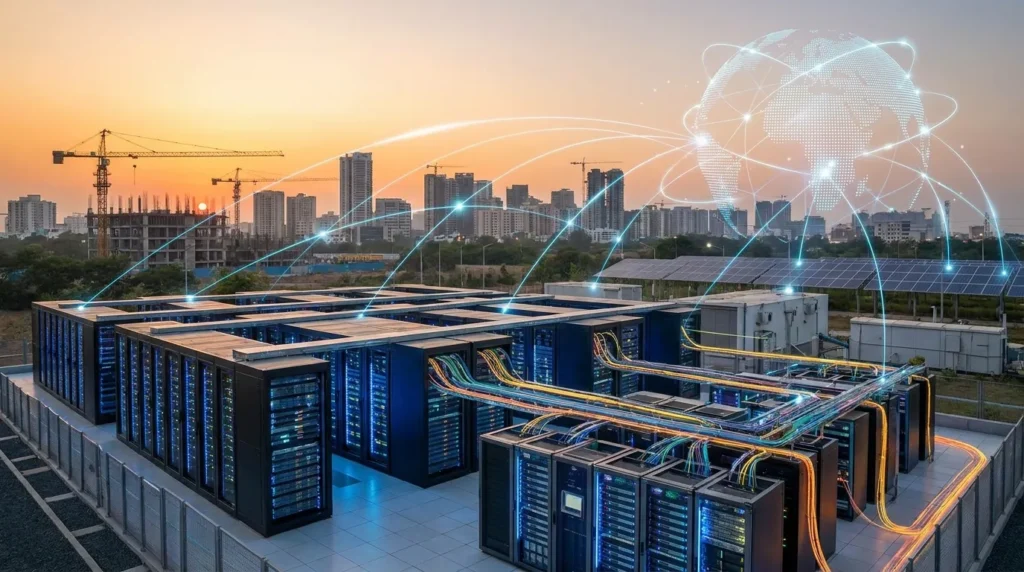

Global infrastructure is quietly shifting eastward. If you track where tech giants are pouring their billions, the biggest question currently circulating among global tech investors is why India is becoming the world’s next data center capital.
It is not just about cheap land anymore. With over a billion active internet users driving relentless digital consumption, the sheer volume of data generated requires localized, high-intensity compute power.
Market intelligence indicates that by the end of 2026, operational capacity will surge past 1.7 gigawatts. The nation is transitioning from basic storage solutions into the core nervous system for global cloud services and artificial intelligence workloads.
Big Investments Building the Next Data Center Capital
Foreign and domestic capital are fundamentally reshaping the physical scenario. We are watching cumulative investment commitments easily cross $126 billion.
Reliance and Adani alone have pledged over $200 billion combined toward AI and digital infrastructure across India over the coming years. Meanwhile, Foreign hyperscalers are strongly moving in.
Meta and Reliance are jointly constructing an AI enabled Data center in Jamnagar, while Google focuses on a $15 Billion infrastructure hub in Visakhapatnam.
The scale of these 2026 deployments proves that Global tech firms no longer view India as merely a backup market. It is now the primary growth engine for heavy compute.
Why AI and Digital Growth Fuel Data Centers Across India
The fundamental technology driving this expansion has entirely shifted. Earlier server racks were built for simple cloud storage, but today’s infrastructure must support the brutal power demands of artificial intelligence.
Processing massive AI training models requires gigawatt-scale energy grids and precision cooling systems. India is actively building out this specific capacity to handle intense digital workloads.
With the deployment of tens of thousands of national GPUs and rapid 5G integration, standard server rooms are practically obsolete.
A modern data center must now function as a massive, liquid-cooled power plant capable of supporting the high-density racks that modern AI protocols demand to function properly.
Government Policies Shaping the World’s Data Infrastructure
Capital only flows where regulations allow it to thrive, and lawmakers have finally aligned with industry needs.
The Union Budget 2026–27 drastically altered the financial math for foreign tech firms operating in India by introducing an aggressive tax holiday lasting until 2047 for global cloud service providers.
Officials also established a 15 percent safe harbor margin for related domestic entities to minimize transfer pricing disputes. These policies officially classify a data center as strategic national infrastructure rather than basic IT support.
Paired with strict sovereignty mandates requiring localized storage, the government is essentially forcing the global tech ecosystem to physically anchor itself locally.
The Future Trajectory for India’s Data Center Capital
The geography of this digital boom is rapidly spreading outward. While Mumbai remains the dominant hub- projected to cross a massive 1 gigawatt of operational capacity alone by late 2026- the market is actively decentralizing.
Secondary cities like Hyderabad, Pune, and Chennai are capturing new investments due to severe land shortages and power grid pressures in primary metros.
The long-term hierarchy of the global technology sector will ultimately be dictated by who can secure reliable power and execute construction fastest.