
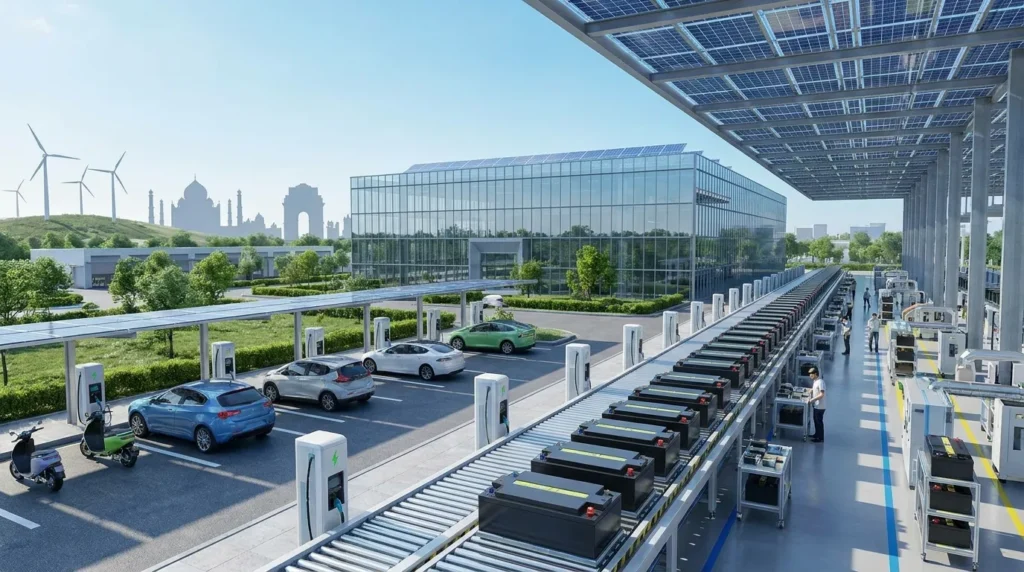

The aggressive transformation currently unfolding across South Asian energy markets represents a sharp departure from decades of reliance on imported refined minerals.
Conglomerates are actively replacing import dependencies with localized gigafactories.
Analyzing the underlying mechanics of this industrial transition answers a critical financial question regarding exactly what is causing the India’s EV battery sector to pull in such big waves of capital.
It fundamentally boils down to structural de-risking. We are tracking capital expenditure commitments exceeding ₹75,000 crore this year alone.
This is not speculative investment. Not even close. Manufacturers are deploying large capital because government intervention is absorbing the initial shock of establishing a deep-tier supply chain.
Capital influx here is merely a predictable reaction to engineered market stability.
Policy Frameworks Pushing Billions Into The Indian EV Battery Sector
The core financial catalyst remains the ₹18,100 crore Production Linked Incentive scheme for Advanced Chemistry Cells.
By mid-2026, the tangible results of this outlay became undeniable as entities like Ola Electric began commercializing indigenous 4680-format ‘Bharat Cells’ and pulling down early disbursements.
However, assembling cells is insufficient without localized raw materials. To plug this severe import vulnerability, the government proposed a highly targeted ₹12,000 crore incentive framework in June 2026.
This specific intervention directly subsidizes the domestic production of critical upstream components, specifically Cathode Active Materials and Anode Active Materials.
These strategic moves systematically dismantle the complex supply bottlenecks that historically derailed similar industrial projects.
When combined with the January 2025 Critical Minerals Mission and the ₹10,900 crore PM E-Drive scheme actively supporting the broader ecosystem, the risk calculus changes entirely.
Large conglomerates and institutional investors require absolute regulatory security before sinking heavy capital into unproven manufacturing hubs.
By aggressively subsidizing both the raw material processing stages and the final cell assembly lines, India has essentially guaranteed the profit margins for early movers.
Consequently, the EV battery sector treats these state-backed policy frameworks as a green light for aggressive localized expansion.
Huge Domestic Demand Drawing The India’s EV Battery Sector Toward Billions
While subsidies initiate factory construction, guaranteed consumption dictates long-term viability. Current 2026 baseline data sourced from the India Energy Storage Alliance now projects a tenfold surge in baseline requirements, targeting approximately 200 GWh of annual capacity by 2032.
To meet this target, over 150 GWh of Cell manufacturing lines are expected to become fully operational by the end of this decade. Industry heavyweights like Tata Agratas, Amara Raja, and Reliance are driving this unprecedented volume.
Their internal Financial models are backed by actual street level market penetration realities rather than hypothetical adoption curves.
By early 2026, domestic Two wheeler electric penetration hit 36 percent.. while three wheeler adoption reached an aggressive 58 percent.
This localized consumption curve guarantees immediate off-take for the new gigafactories pouring off the assembly lines.
If manufacturers manage to produce the cells at scale, the domestic transport market will consume them immediately.
No export reliance required. This guaranteed localized demand serves as the primary economic catalyst justifying the major capital influx.
Ultimately, investors are pouring money into the EV battery sector simply because the consumer base has crossed the critical adoption threshold, permanently altering transport economics.