
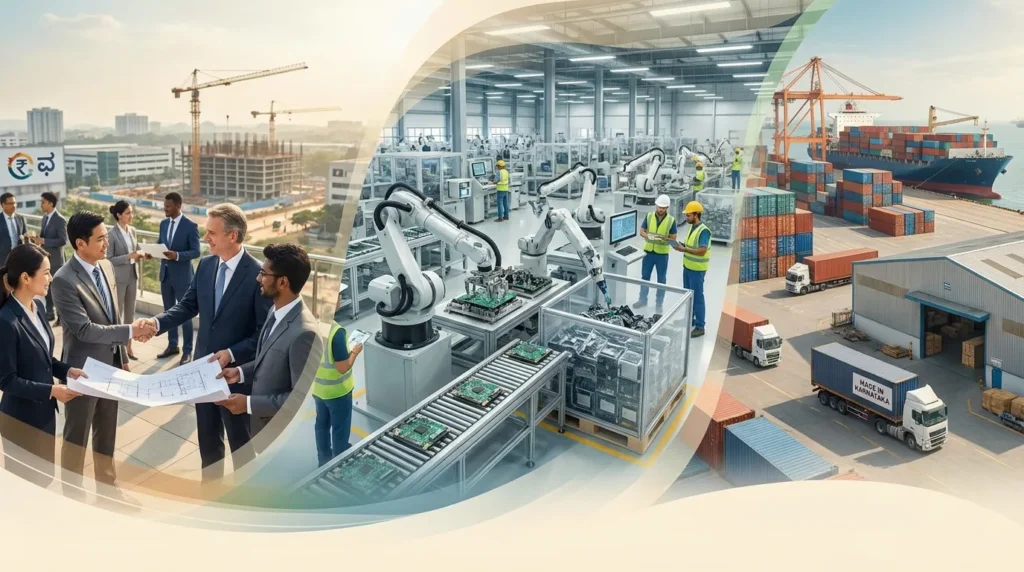

Bengaluru is often the first thing people think of- the traffic, the pubs, the endless sea of tech parks. But looking at the fiscal data for 2025–26, there is a much bigger story playing out across the entire state.
Karnataka isn’t just coasting on its reputation as a software hub anymore. It has fundamentally re-engineered how it attracts international capital, which explains why Karnataka is one of India’s top FDI destinations even as global markets feel a bit shaky.
It isn’t just about having the most engineers. It’s about the sheer aggressive nature of the state’s latest policy shifts. The numbers from the first half of 2026 show a massive 2.6-fold increase in foreign inflows compared to previous cycles. That doesn’t happen by accident.
Breaking down the 2025-30 policy that keeps Foreign money flowing into Karnataka
The “Karnataka Industrial Policy 2025–30” hit the ground running earlier this year, and it’s a beast. It moved away from generic promises to very specific, hard-to-ignore incentives.
We are talking about a 25% capital expenditure subsidy for companies that actually build stuff here. The state wants a 12% annual manufacturing growth rate, and they are putting their money where their mouth is.
Investors aren’t just looking for a tax break; they want a place where they can actually set up a shop without losing three years to red tape.
The state’s “Ease of Doing Business” updates in late 2025 simplified the land acquisition process, making it significantly faster for a German or Japanese firm to break ground in an industrial park than it is in almost any other Indian state.
Semiconductors and the massive high-tech manufacturing boom
For a long time, Karnataka was the “Back Office of the World.” That label is dead. By 2026, the focus switched towards hardware. The Semiconductor pipeline alone is worth roughly $50,000 Crore.
With players like Foxconn & Applied Materials expanding their footprints, the State has built a cluster that feels more like Hsinchu in Taiwan than a traditional Indian city.
The aerospace sector is another heavy hitter. Belagavi has quietly become a global hub for precision engineering. When a Boeing or an Airbus looks at India, they aren’t looking at Delhi or Mumbai for manufacturing; they are looking at the specialized clusters Karnataka spent a decade building.
How the 2024 GCC policy changed the game for FDI in Karnataka
One of the smartest moves the government made was the Global Capability Center (GCC) policy launched in late 2024. Karnataka was the first state to do this. Instead of just hosting outsourced work, these GCCs are now the global nerve centers for Fortune 500 companies. We have over 600 of these centers now.
They aren’t just call centers; they are where the R&D, the AI patents, and the global finance strategies are born. This high-value investment is a huge reason for the massive FDI in Karnataka numbers we see in the latest quarterly reports.
Why investors are finally looking past Bengaluru to Tier-2 cities
The ‘Beyond Bengaluru’ initiative finally stopped being a tagline and started being a reality in 2026. If you go to Mysuru, Hubballi-Dharwad, or Mangaluru right now.. you’ll see the FDI shifts in real time.
The infrastructure is catching up, the land is cheaper, and the talent is migrating back home.
By pushing incentives for electronics and green energy into these Tier-2 cities, the state has avoided the “one-city” trap. It’s a diversified portfolio. Whether it’s clean energy projects in the north or port-led logistics in the west, the state has created a multi-engine growth model that keeps the FDI coming in from every direction. The momentum is real, and the 2026 data proves it’s not slowing down.