
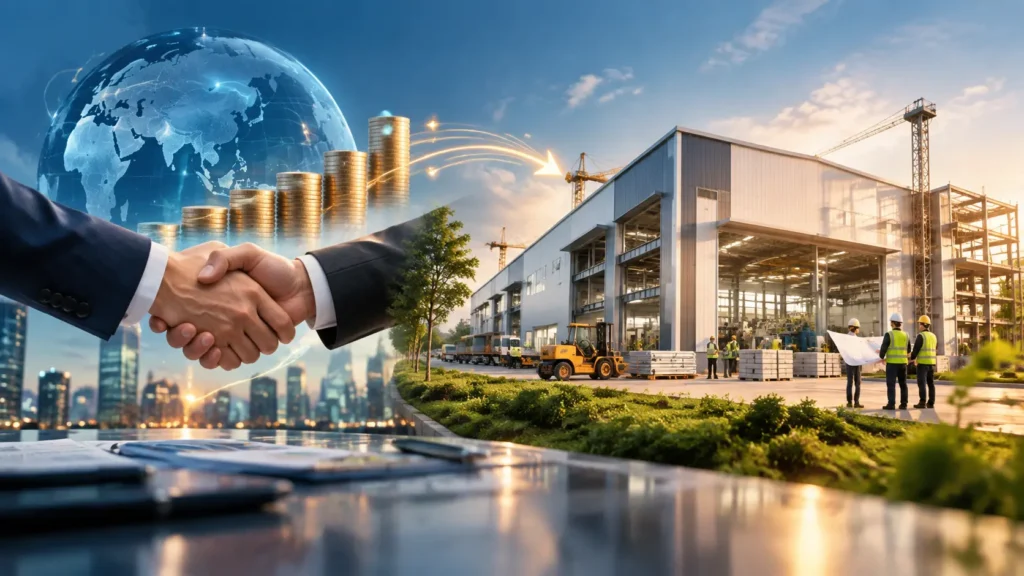

The visual reality of the 2026 manufacturing boom looks like heavy earthmovers tearing up dirt in places like Vietnam or Karnataka’s Tier-2 cities.
We are living through a big post-2025 global supply chain realignment. If you want to understand exactly what role FDI plays in building new local factories right now, you just need to follow the billions going into these huge greenfield projects.
Foreign direct investment is the new raw, physical fuel constructing the world’s newest industrial belts from the ground up, and it’s happening at a pace we haven’t seen in decades.
Foreign Direct Investment Fuels the Greenfield Factory Boom
Real companies in 2026 aren’t just buying up old, outdated plants and slapping a new logo on the door. They are starting entirely from scratch. This surge is purely about “greenfield” FDI.
Look at India’s major push with its Production-Linked Incentive schemes. Moving into 2026, that initiative alone pushed past ₹2.16 lakh crore in capital commitments.
This cash flows specifically to build brand-new facilities for electronics, semiconductors, and EV components. Foreign capital directly funds the land acquisition, the poured concrete, and the heavy machinery required to get these sites operational. The capital intensity is harsh, but the resulting physical footprint is undeniable.
How Local Factories Benefit From FDI Driven Technology
Setting up a new manufacturing plant takes a lot more than just a fat checkbook. When multinational giants drop capital into a new local zone, they drag advanced tech transfers along with them.
The 2026 wave of factory building isn’t about cheap labor; it involves AI-driven logistics, precision engineering, and strict net-zero green manufacturing standards.
Local economies flat-out couldn’t afford to build at this technological level without international capital forcing the upgrade.
A big chunk of the $270 billion pumped into greenfield digital infrastructure is doing exactly that- imposing cutting-edge intellectual property onto local soil.
It forces regional manufacturing ecosystems to either modernize overnight or get left behind completely.
FDI Building New Local Factories Reshapes Global Supply Chains
Why is this build-out happening right now? The “China Plus One” strategy is no longer just a theory.. it is a rigid survival tactic in the harsh tariff environments dominating 2026.
Foreign investors fund local factories in alternative markets just to bypass trade restrictions and secure their bleeding supply lines.
This foreign money effectively creates dense, integrated local manufacturing hubs that protect regional economies from global shipping shocks.
They are building localized fortresses of production, drastically shrinking the geographic distance between where a product is made and where it is consumed.
Real Economic Impact of Local Factories Built by Foreign Capital
These foreign funded Factories do not exist in a vacuum. Drop a large anchor factory into an underdeveloped region, and it immediately forces the creation of heavy Infrastructure like high-capacity Power grids, freight roads, and Industrial water treatment plants.
It triggers a fast, aggressive ripple effect for local micro and small enterprises who inevitably step up to supply these giant facilities with raw materials.
Basic jobs are created, sure, but more importantly, the local workforce is forced to upskill to handle modern, computerized machinery. A regional economy’s industrial survival in the late 2020s entirely depends on keeping this foreign capital flowing.