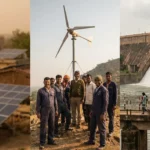


India is at a magisterial turning point in its energy history. As of early 2026, the country has not just toyed with the idea of a green transition- it has effectively overhauled its power grid. With non-fossil fuel capacity now exceeding 283 GW- roughly 52% of the total installed base- the focus has shifted entirely to the home stretch of the 500 GW goal by 2030.
While government policy provided the blueprint, the real heavy lifting has been done by a relentless wave of foreign capital.
International investors are no longer looking at the Indian renewable space as a speculative bet. Instead, they see it as the most reliable theatre for large-scale, asset-backed returns in the global south. It is about money, yes, but also about survival in a warming world.
Open-minded FDI Frameworks Speeding Up the Green Transition in India
The sheer scale of this transformation relies on a financial environment that is arguably the most liberal in the world for energy.
The Indian government’s decision to allow 100% FDI under the automatic route for renewable generation, distribution, and manufacturing has removed the bureaucratic sludge that usually stalls such massive infrastructure shifts. Even more telling is the pragmatic recalibration of investment rules in April 2026.
By allowing non-controlling stakes from investors in neighboring countries to bypass long approval wait times, India has cleared the path for a new wave of technology transfers. This isn’t just about cash flow. It’s about the hardware needed to build the 500 GW backbone. Fast, efficient, and direct.
A Surge in Global Investment Scaling India Across the 500 GW Horizon
Look at the numbers from 2025 to see the momentum. The solar sector alone drew over $2.37 billion in foreign investment last year, even as broader global energy investments faced a cooling period.
This capital didn’t just go into ground-mounted solar parks in Rajasthan. It funded a 55 GW annual addition cycle, the highest in India’s history. Sovereign wealth funds and global pension groups are now moving beyond just buying stakes in existing plants.
They are funding the ‘upstream’ move into Solar cells and Wafers. And this fills a critical gap in the domestic supply chain. This change ensures that as the Country races toward 500 GW, it isn’t just importing panels.. but building the industrial capacity to sustain itself.
Securing the Billions Needed to Finalize India and the 500 GW Ambition
However, the road to the final 500 GW mark requires more than just adding Panels and Turbines. To keep the grid stable, India needs to pour $350 Billion into generation, storage & transmission over the next few years. That is a massive number. We are seeing a massive pivot in how FDI is deployed because of it.
Foreign players are increasingly eyeing the battery storage market and the national Green Hydrogen mission. With 41 GW of storage capacity planned to handle the intermittent nature of solar and wind, the investment profile is becoming more complex and more integrated.
This isn’t a “hopeful” future anymore; it’s a maturing market. The 500 GW target once felt like a lofty political statement, but today, it’s a multi-billion-dollar infrastructure project with global fingerprints all over it. The transition has moved past the experimental phase and into an era of strategic, high-value bets.