
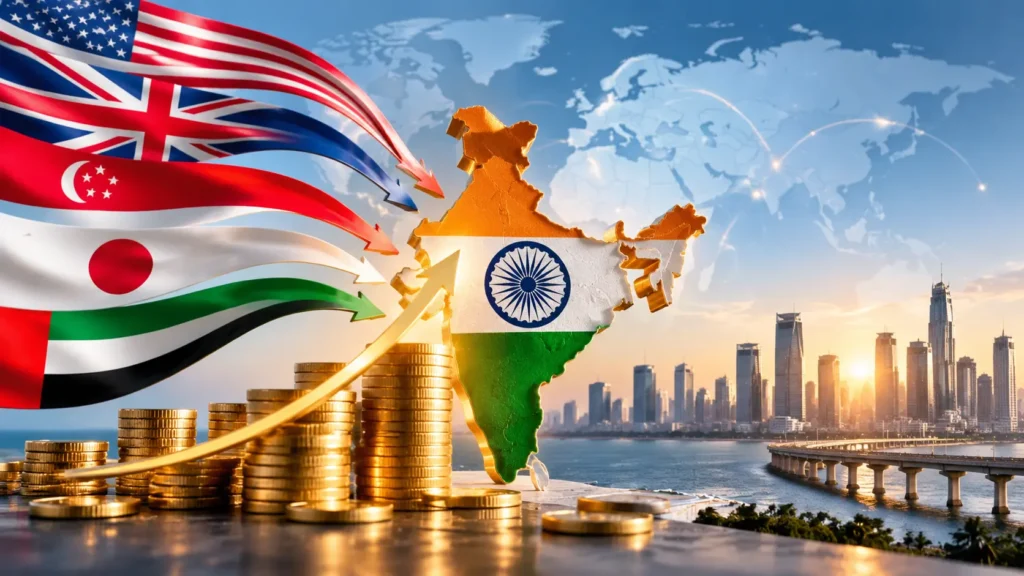

If you track the data to determine the country which gifted the highest FDI to India in 2025, you would quickly realize the bulk of this foreign capital wasn’t flying in directly from Silicon Valley or London.
Instead, it routed through a highly efficient, much smaller financial hub in Southeast Asia. Singapore continued to dominate as the primary conduit for foreign direct investment into the Indian economy.
Total inward FDI hit roughly $81 billion during FY2024-25 period, proving India’s sheer market gravity, but where that money stopped before crossing the border revealed exactly how international finance operated.
Singapore Delivered the Highest FDI In India In 2025
When looking at the hard numbers for that fiscal period, Singapore completely overtook the rest of the world. It accounted for roughly 30% of total FDI equity inflows, pushing over $14.9 billion directly into the domestic economy.
This huge influx wasn’t just local Singaporean money looking for a home. Global corporations consistently used Singapore as a strategic holding structure.
The reasons were purely pragmatic. Singapore offered highly favorable Tax treaties with India, English-language contract norms, and a ‘Common-law-aligned’ legal environment that made corporate dispute resolution straightforward.
Intellectual consensus pointed to these regulatory frameworks as the real magnet for routing.
Investors wanted exposure to India’s fierce growth trajectory but demanded the legal buffering that Singapore’s financial ecosystem easily provided.
The top spot was less about geographic proximity and entirely about institutional trust.
The American Investment Surge and Mauritius Decline in 2025
Singapore’s lead only told half the story when mapping out the runners-up. The most intense change in capital origins came from the United States.
US inflows practically doubled, pushing past the $5.4 billion equity mark and securing an 11% share of the total pie. American funds targeted tech startups and advanced manufacturing, driven by a deliberate pivot away from other Asian manufacturing bases.
Conversely, the data showed the sharp decline of Mauritius. Historically the undisputed champion of Indian FDI due to legacy Tax loopholes, Mauritius slipped down to second place, retaining about 17% of the share.
As regulatory frameworks tightened and the Indian government renegotiated double-taxation treaties, the Island nation lost its primary competitive edge, forcing Global wealth to reroute.
Tracking Where the Foreign Capital Actually Landed
Foreign money didn’t spread evenly across the subcontinent. It created severe regional concentrations. Capital from Singapore and the US disproportionately targeted just two states. Maharashtra captured nearly 39% of all inflows, maintaining its grip as the absolute center of finance and heavy industry.
Karnataka followed with 13%, riding entirely on the back of its sprawling technology ecosystem. The specific sectors hoarding this cash explained the state-level disparity.
The Services sector and Computer Software and Hardware industries combined took the overwhelming lion’s share of these foreign funds. International investors were not building generic infrastructure; they bought into digital scalability and enterprise services.
The data proved that while India’s market size attracted investors, the actual mechanics of moving money relied on a few trusted international corridors.
The heavy reliance on Singapore and the US highlighted a permanent preference for tech-heavy investments and regulatorily predictable routing. Global funds tolerated emerging market risks, but only when channeled through the safest possible financial plumbing.