
Raw silicon is basically just expensive, incredibly fragile sand until someone actually bothers to wire it up and wrap it in protective plastic.
You can bake all the 3-nanometer wafers you want, but without a physical board to sit on or a resin casing to keep the microscopic circuitry from snapping under thermal stress, it’s just a shiny coaster.
If you’re trying to figure out why billions in foreign capital are suddenly flooding into dusty industrial parks, breaking down PCBs, OSAT, and ATMP is how the hardware FDI alphabet is explained. It’s an absolute panic.
Investors are desperately pouring Hardware FDI into Assembly, Testing, Marking, and Packaging (ATMP) setups, Outsourced Semiconductor Assembly and Test (OSAT) facilities, and foundational Printed Circuit Boards (PCBs) to avoid being caught empty-handed when the next geopolitical supply shock hits.
Decoding OSAT and ATMP in the Hardware FDI Boom
Let’s get the physical reality straight. Outsourced Semiconductor Assembly and Test (OSAT) and Assembly, Testing, Marking, and Packaging (ATMP) aren’t abstract cloud processes.
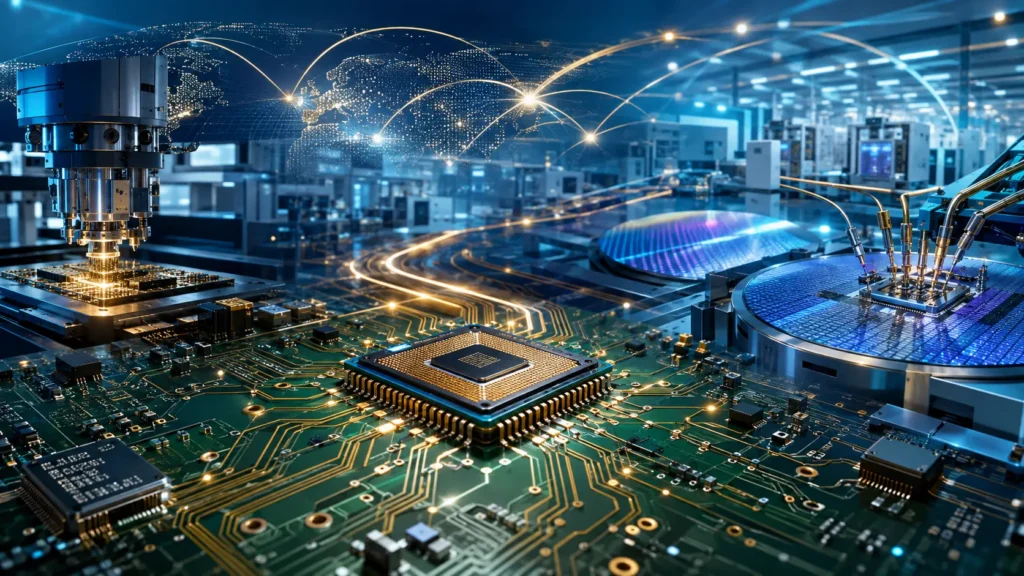
It is literally slicing up chemically treated silicon, probing it for microscopic defects, and injecting it into epoxy resin. And right now, it’s sucking up massive global Hardware FDI. Take a look at India’s map in mid-2026.
Micron’s Sanand facility is already spitting out memory modules. Tata is pushing dirt around in Assam, pouring billions into a greenfield semiconductor plant, while Suchi Semicon breaks ground in Surat.
The money flowing into OSAT and ATMP facilities guarantees the bare die can actually talk to the PCBs. It’s a messy, highly chemical process. But it works.
Why PCBs Are the Skeleton of Hardware FDI Strategies
You can’t just glue a packaged chip to a dashboard. Printed Circuit Boards (PCBs) are the literal, physical skeleton of this ecosystem. Realizing domestic board manufacturing was lagging behind packaging led to a desperate policy shift.
By early 2026, the government started fast-tracking Hardware FDI approvals for component manufacturing, quietly waving through money from countries sharing land borders.
A glaring admission that we need the underlying infrastructure. Local manufacturers like Kaynes Technology are scrambling to scale up bare board production.
If an OSAT plant finishes a batch of logic chips, or an ATMP facility rolls out fresh microcontrollers, they are useless without the copper tracks of PCBs to route their power.
Connecting PCBs OSAT and ATMP to Global Hardware FDI
The geopolitical panic driving this is a terrified, breathless realization that everything from heavy EV powertrains to military radar arrays relies entirely on a frighteningly fragile supply chain where a single delayed shipment of laminated boards can shut down a factory floor for six months. Boom. Dead in the water.
So they spend. Institutional investors are dumping aggressive Hardware FDI to build redundant capacity. The strategy is to fund PCBs alongside OSAT setups and ATMP plants in one localized cluster. Isolate packaging from board production, and you still fail.
The Future of Hardware FDI in PCBs OSAT and ATMP
We aren’t just watching a temporary spike in tech funding. The current wave of Hardware FDI is physically altering the industrial dirt in places like Dholera and Sanand, dragging complex manufacturing away from legacy hubs.
Whether it’s the resin-heavy floors of an ATMP plant, the sterile testing rooms of an OSAT provider, or the chemical baths required for high-density PCBs, the money has already cleared the bank. The concrete is poured.