
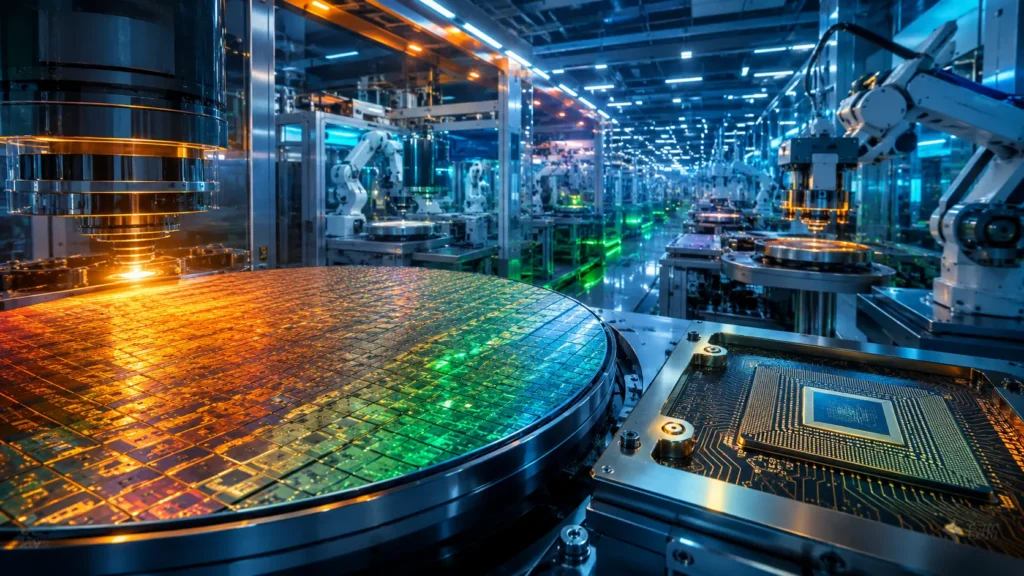

Do you remember the headache of 2022? We were waiting eight months to get the keys to a regular Hyundai just because a single dirt cheap Silicon component was stuck on a rusting cargo Ship somewhere in the South China Sea.
You could almost feel the metallic taste of sheer frustration every time a delivery date was pushed back again.
That absurd supply chain chokehold is the exact reason we are looking squarely at the reality that ISM 2.0 is here- what the new Chip Mission changes now is no longer a theoretical whitepaper exercise, but a brute-force industrial correction. India is done waiting in line.
The government finally realized that begging foreign companies to assemble imported parts wasn’t actual self-reliance. It was just a different kind of dependency.
Why India Shifted Gears With ISM 2.0
Throwing billions at basic fabrication plants was a temporary band-aid. Finance Minister Nirmala Sitharaman’s Union Budget 2026–27 announcement for ISM 2.0 made it brutally clear that Phase 1 was just an expensive warm-up.
They allocated a tight ₹1,000 crore initial provision for FY27. But behind closed doors at MeitY, they are hashing out a massive ₹1.2 lakh crore overall outlay. Because building a genuine hardware ecosystem takes well over a decade.
The old five-year strategy was completely delusional. So the updated Chip Mission is stretching its timeline to 12 years to actually force private money into the market instead of just handing out blank government cheques.
They even hiked the Electronics Components Manufacturing Scheme outlay to an aggressive ₹40,000 crore to capture the current momentum. This is how India actually secures a physical supply chain.
The Real Changes In The Chip Mission Strategy
The midstream party is officially over.
Under Phase 1, the government blindly subsidized 50% of basic assembly and testing facilities. Not anymore. They are slashing that support down to 30%.
They want companies to stop simply gluing imported parts together and start making the dirty, unglamorous upstream materials- specialty gases, caustic chemicals, bare silicon wafers, and actual manufacturing equipment.
The updated Chip Mission actively starves lazy packaging firms to force the industry into designing full-stack IP locally, like indigenous processors.
ISM 2.0 is aggressively shifting the cash toward deep-tech hardware because true technological sovereignty requires owning the raw materials. India is actively punishing companies that refuse to innovate.
How ISM 2.0 Positions India Globally
The geopolitical math is incredibly ugly. The domestic market is sitting at roughly $45 billion right now, and the administration genuinely expects it to cross $100 billion by 2030. That is an absurdly terrifying scale-up.
They even published a roadmap to somehow hit 3-nanometre and 2-nanometre tech nodes within a decade. Good luck with that. Taiwan, South Korea, and the US have held an absolute monopoly over this sector for forty years. And they are not going to just hand over their precious market share because India asked nicely.
The Chip Mission is essentially a declaration of economic warfare against established manufacturing giants. If ISM 2.0 actually works, it completely breaks the global hardware cartel.
If it fails, we are stuck buying expensive foreign silicon from Taipei forever. And no amount of government press releases will fix that.