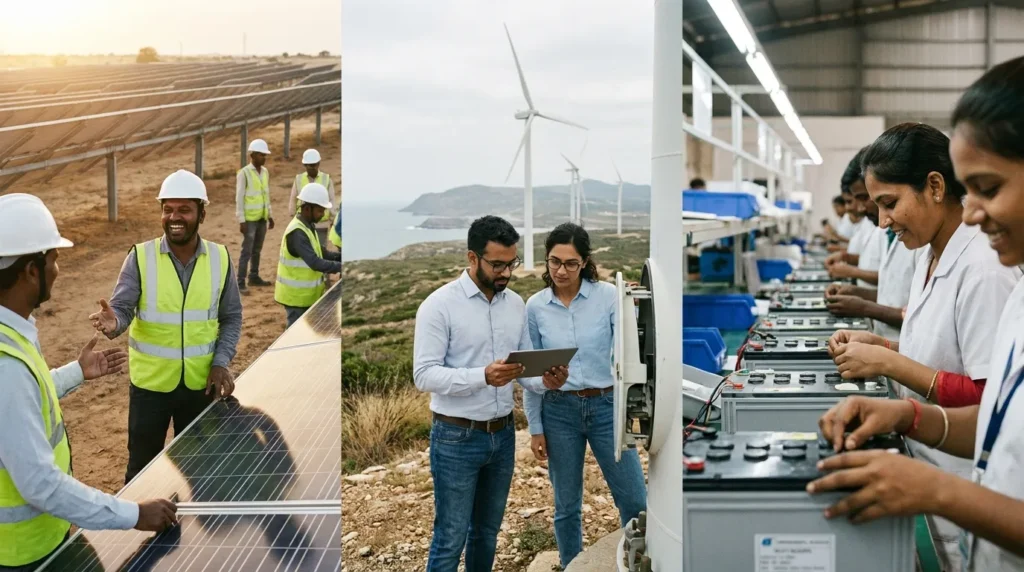

As we move through 2026, the data shows a clear, undeniable link between the surge of international capital and the millions of families now supported by the green sector.
Looking at how Renewable Energy FDI is creating jobs in India, we see that the influx of roughly $25 billion in cumulative foreign investment has turned the energy sector into a primary engine for national employment.
The Concrete Connection between Renewable Energy FDI and Jobs Opportunity
The math is simple: international money builds physical infrastructure, and infrastructure requires human hands. By the start of 2026, India’s renewable energy workforce expanded to over 1.4 million active jobs.
When a Danish wind giant or a Canadian pension fund pours capital into a 500 MW project, they aren’t just buying turbines. They are funding a three-year lifecycle of site engineers, environmental impact assessors, and grid integration specialists.
We are also seeing a massive jump in high-skill requirements. FDI has brought more than just cash; it has brought global technical standards. This forced a rapid upskilling of the Indian workforce.
Today, a solar technician in Karnataka isn’t cleaning panels alone. They are often managing AI-driven software that predicts cloud cover and adjusts grid loads in real-time. This tech transfer, funded by foreign players, has made the Indian energy professional a high-value asset on the global stage.
Why Local Manufacturing Ecosystems depend on Global Investment Cycles
The real shift in 2026 is the move from “import and install” to “make and maintain.” Driven by the Production Linked Incentive (PLI) schemes and backed by foreign venture capital, India has seen a 35% year-on-year increase in domestic solar module manufacturing capacity. Foreign investors are no longer content shipping parts from overseas; they are setting up shop in Tamil Nadu and Gujarat.
This manufacturing pivot creates a “multiplier effect” for Jobs. For every gigawatt of solar capacity installed, the supply chain now supports thousands of indirect roles.
We are talking about glass manufacturing, aluminum framing, and specialized logistics. These aren’t just temporary construction gigs. They are stable, long-term industrial roles that form the backbone of a new middle class.
Transforming Rural Employment through Sustainable Infrastructure Flows
The geography of India and its renewable potential means that the bulk of this FDI flows into historically “power-poor” or arid regions. Massive solar parks in Rajasthan and wind farms in the remote stretches of Andhra Pradesh have fundamentally changed the local economy. In these areas, green energy is often the first major employer that doesn’t involve seasonal farming.
It has slowed the desperate migration to overpopulated cities. When a foreign-funded utility-scale project breaks ground in a village, it creates a localized economy of maintenance crews, security, and administrative staff. It’s a quiet revolution.
Preparing the Ground for a Two Million Strong Workforce by the Decade End
As we glance toward the 2030 target of 500 GW, India will have to sustain an annual Investment of nearly $35 billion. The current trajectory suggests that the workforce will swell to 2 Million people within the next four years.
The synergy between global capital and local labor is no longer a theoretical benefit. It is the reality of the Indian economy. The money coming from across the borders is doing more than just lighting up bulbs; it is putting people to work in the most stable, forward-looking industry the country has ever seen.