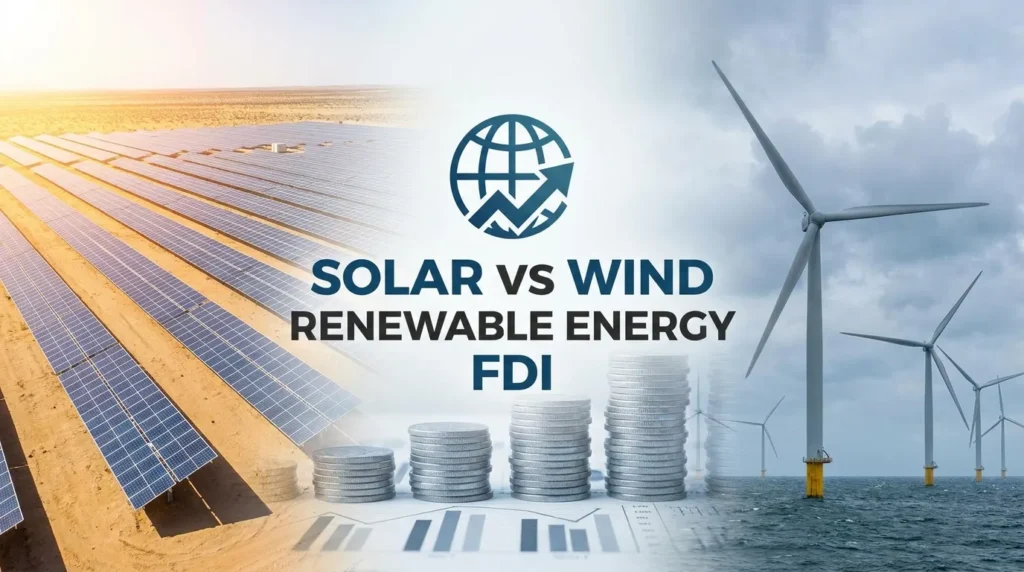

The global scramble for clean energy isn’t just about carbon targets anymore- it is about where the hardest currencies are landing. As we move through the second quarter of 2026, the data shows that the answer to the big question of Solar vs Wind: Where Is Most Renewable FDI Going? has become increasingly lopsided.
Investors are pouring cash into photovoltaic panels at a rate that makes the wind sector look almost sluggish by comparison. While both technologies are necessary for a net-zero grid, the “velocity” of capital favors the sun.
Capital Shifts and the Current State of Renewable FDI
The volume of Foreign Direct Investment (FDI) into renewables reached a staggering $750 Billion globally in 2025. And 2026 is on track to eclipse that. But this money is not allocated evenly. Investors are risk averse. They want projects with short lead times and predictable supply chains.
This is where the divide starts. Solar projects can go from a “final investment decision” to producing power in less than eighteen months. Wind, especially the massive offshore arrays currently being planned, can take five to ten years to clear regulatory and logistical hurdles. Because of this, nearly 65% of all renewable FDI in the last year flowed into solar-related ventures.
Solar Power Dominance in the Foreign Direct Investment Context
Solar remains the undisputed hero of the energy transition. The reason is simple. It is modular. You can build a 5MW farm or a 500MW plant using roughly the same components. In 2025, the cost of solar modules dropped another 12%, making the “Return on Investment” (ROI) calculation a no-brainer for private equity firms in New York and London.
We are also seeing a massive pivot in FDI toward manufacturing. Instead of just buying power, investors are funding the factories that build the cells. This “vertical integration” is sucking up billions of dollars that used to be spread across multiple energy types.
Why Wind Energy Investment Faces Different Hurdles than Solar
Wind energy is struggling with a “lumpy” investment cycle. The FDI into wind is often concentrated in massive, multi-billion-dollar deals that happen once every few years. While a wind turbine has a higher capacity factor than a solar panel- meaning it generates power more consistently- the upfront CAPEX is a nightmare.
In 2024 and early 2025, high interest rates hit the wind sector hard. When you are borrowing $2 billion for an offshore wind farm, a 1% shift in interest rates can kill the project’s viability. Solar just doesn’t have that level of sensitivity to the debt markets because the projects are smaller and more digestible.
Tracking Where the Smart Money Sits in the 2026 Energy Market
The 2026 investment situation is clear. Solar is fast, cheap to install, and increasingly easy to store thanks to better battery integration. Wind is essential for the “baseload” of a green grid, but the slow permitting and massive steel requirements make it a harder sell for international investors.
If you follow the money, it is heading toward the sun. Solar is winning the FDI race not because it is “better,” but because it is faster. And in a high-inflation, high-demand world, speed is the only metric that truly matters to the people holding the checkbooks. No fluff, just the cold reality of the 2026 market.