
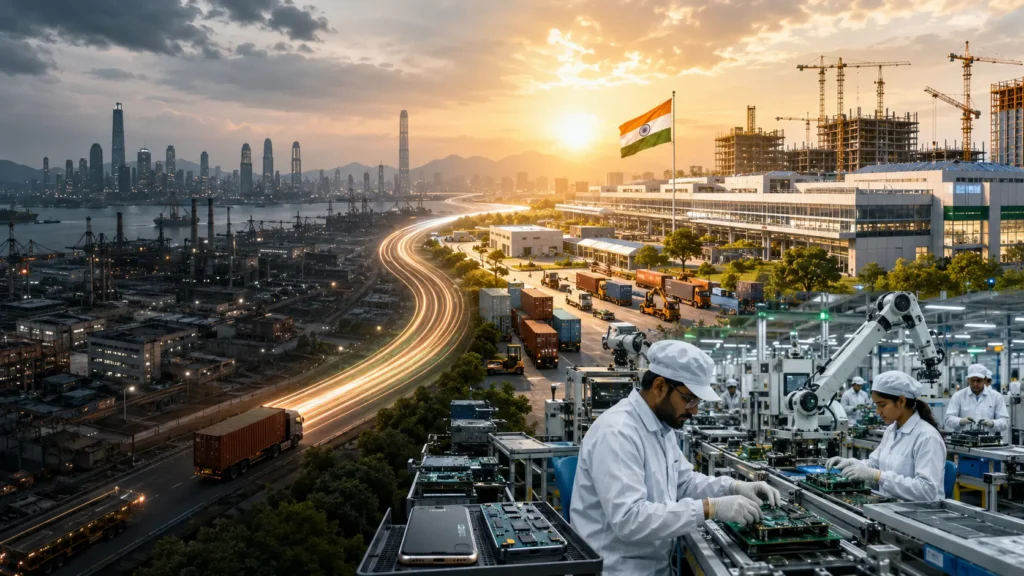

The global electronics Supply chain is harshly ripping up decades of established blueprints. To understand the exact financial, geopolitical, and strategic catalysts driving this change, one has to track something hidden here.
And that is to know why the Taiwanese contract manufacturing giant is aggressively uprooting its primary assembly networks from its traditional eastern stronghold to plant its future flagship operations within the subcontinent.
The scale of this transition became undeniable in early 2026 when Foxconn injected an additional $1.5 billion into Yuzhan Technology in Tamil Nadu.
That huge Capital commitment proves this is not a mere diversification tactic, but a permanent structural break. Boardrooms are tacitly accepting that relying on a single Geographic hub carries unacceptable financial risk.
While China previously offered unmatched economies of scale for Consumer electronics, the calculus turned. High-volume assembly requires favorable export math and strict political alignment, two metrics where India now presents a significantly more attractive proposition for securing long-term tech dominance.
Geopolitical Pressures Pushing Foxconn from China to India
The immediate catalyst for this industrial exodus comes down to severe trade friction. Recent political mandates have aggressively penalized technology exports originating from older bases.
Following harsh U.S. Tariff hikes in April 2025, Hardware shipments from China faced punishing costs reaching 54%. That hit instantly annihilates the thin profit margins typical in contract manufacturing. Corporations cannot just absorb those costs without destroying Market demand.
Looking for immediate relief, manufacturers found a critical escape route in India, where tech exports benefit from a vastly reduced 26 percent rate. Foxconn essentially had no choice but to physically relocate chunks of production capacity.
Geopolitics transformed a theoretical risk into a financial hemorrhage that required a physical geographic solution to protect baseline profitability.
State Subsidies Making India a Better Financial Bet for Foxconn over China
Push factors only partially explain the transition, as aggressive economic incentives have actively pulled manufacturing south. The Production Linked Incentive scheme altered the operational math for setting up heavy industry.
By the end of fiscal year 2025, this state subsidy program handed thousands of crores in direct financial payouts to compliant manufacturers.
These cash interventions bridged the historical infrastructure gap that previously made it economically unviable to build mega-factories outside of established eastern hubs.
While China currently grapples with rising labor costs and strict limits on technology transfers, India is heavily subsidizing the initial capital expenditure required to lay down modern assembly lines.
For Foxconn, taking state money to offset construction overhead mitigates the financial risk of abandoning fully optimized legacy factories.
Semiconductor Goals and AI Ambitions Rooting Foxconn in India rather than China
This transition has already evolved past basic smartphone assembly and low-margin hardware production. The physical infrastructure breaking ground points toward a highly advanced technological ecosystem.
In February 2026, Foxconn initiated construction on a ₹3,700 crore OSAT semiconductor facility in Uttar Pradesh, executed as a joint venture with HCL.
Paired with an additional ₹15,000 crore investment aimed at AI-driven advanced manufacturing in Tamil Nadu, the corporate strategy is obvious. They are building a localized chip-to-device pipeline that does not rely on foreign component imports.
The long-term corporate wager rests heavily on India developing the required physical grid to sustain these next-generation facilities. Rather than attempting to upgrade legacy factories in China under heavy trade restrictions, the manufacturer chose a blank slate for its highest-value future projects.