
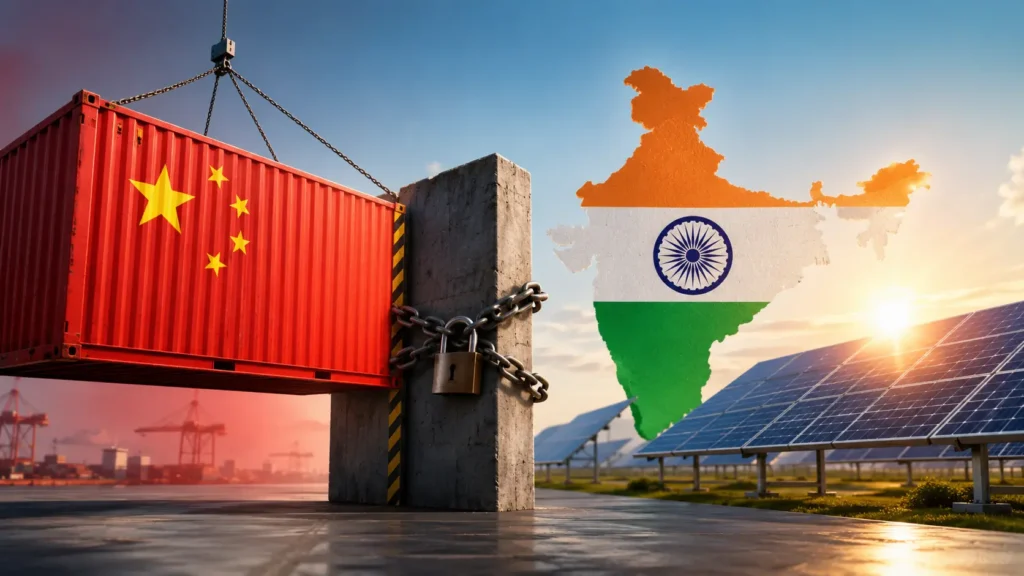

Late last month, New Delhi quietly blocked a WTO dispute panel request over renewable energy incentives. It barely made page four of the financial dailies. Just a tiny blip in the news cycle.
But that bureaucratic stiff-arm was the ultimate signal. Everyone keeps waiting for the diplomatic freeze to thaw, assuming money talks loud enough to melt border tensions. Not exactly. This article rips into the actual, gritty mechanics of why the cash pipeline remains completely severed for mainland companies trying to buy into the local market.
We are dissecting the exact reasons why China FDI is being systematically starved out of the Solar Sector in India, and spoiler alert- it has absolutely nothing to do with free market economics. It’s a calculated, iron-clad blockade designed to suffocate foreign leverage.
The Press Note 3 Trap Blocking China FDI
Look at the legislative core of the situation. Back in March, the government floated some supposed “easements” to the infamous Press Note 3 rules. Bureaucrats patted themselves on the back for allowing tiny, non-controlling stakes under ten percent.
A completely hollow victory. If you are building a massive gigawatt-scale manufacturing plant, you don’t drop billions just to sit in the passenger seat.
The bureaucratic wall preventing meaningful China FDI remains entirely intact. The local administration wants the bleeding-edge technology but outright refuses to give up the steering wheel. It is an intentional chokehold.
For anyone trying to dominate the Solar Sector, doing business in India feels like trying to assemble a watch while wearing boxing gloves. They take your capital, give you zero boardroom control, and force you to smile for the press cameras.
India Demands Complete Solar Sector Independence
The smoking gun dropped just yesterday, June 1st, with the aggressive new ALMM List-II mandate. Local factories can promptly assemble nearly 200 Gigawatts of modules a year.. which sounds great until you realize they only have the capacity to bake about 30 Gigawatts of actual cells.
Right now, factories rely heavily on imported mainland cells to bridge that massive, glaring gap. So why block the money? Because cutting off China FDI forces the domestic manufacturing ecosystem to grow from scratch.
It is brutal, brute-force protectionism. Sure, this relentless push for Solar Sector sovereignty is currently jacking up the price of consumer rooftop installations by around ₹3,000 per kilowatt across India.
The government knows it hurts the end consumer. They just don’t care. The pain is considered a necessary down payment on long-term energy independence.
Why Geopolitics Keeps China FDI Out Of The India Solar Sector
Economically, locking out a nation that controls over eighty percent of the global value chain for renewable tech is an incredibly expensive self-goal. It defies basic financial logic.
But geopolitics doesn’t care about your quarterly spreadsheets. Between a glaring $99 billion trade deficit and the lingering, hyper-paranoid border standoffs, national security simply beats cheap electricity. Period.
New Delhi would rather pay a massive premium and suffer through years of agonizing supply chain bottlenecks than let foreign state-backed giants control the grid’s foundation.
Pushing out China FDI isn’t a temporary negotiating tactic to get better pricing.. it is the entire permanent strategy. As long as military anxiety dictates trade policy, the Solar Sector in India will remain an isolated fortress. They are buying time, no matter how much it costs.