
Delhi’s air quality has been a running joke for years. The smog is choking the city. And vehicular emissions are the biggest culprits.
So, when the Government drops a financial bomb to fix the transport ecosystem, people pay attention.
Analysts, automakers, & everyday commuters are rushing right now to figure out exactly what is Delhi EV Policy 2.0.
A ₹15,000 Crore plan of this scale is a total overhaul. Unveiled by CM Rekha Gupta, this framework kicks in on July 1, 2026. And it will stay active until March 2030.
Decoding What is Delhi EV Policy 2.0 and the Rs 15000 Crore Plan
You cannot transition a city of millions without serious cash. The policy allocates a ₹15,000 crore budget over four years to make it happen.
Roughly ₹7,000 crore is carved out for promotional initiatives and transitioning government and legacy fleets.
The remaining ₹8,000 crore goes directly into buyer subsidies and building a massive charging network.
And what is the ultimate goal? It is to ensure 95% of all newly registered Vehicles in the capital are Electric by 2027.
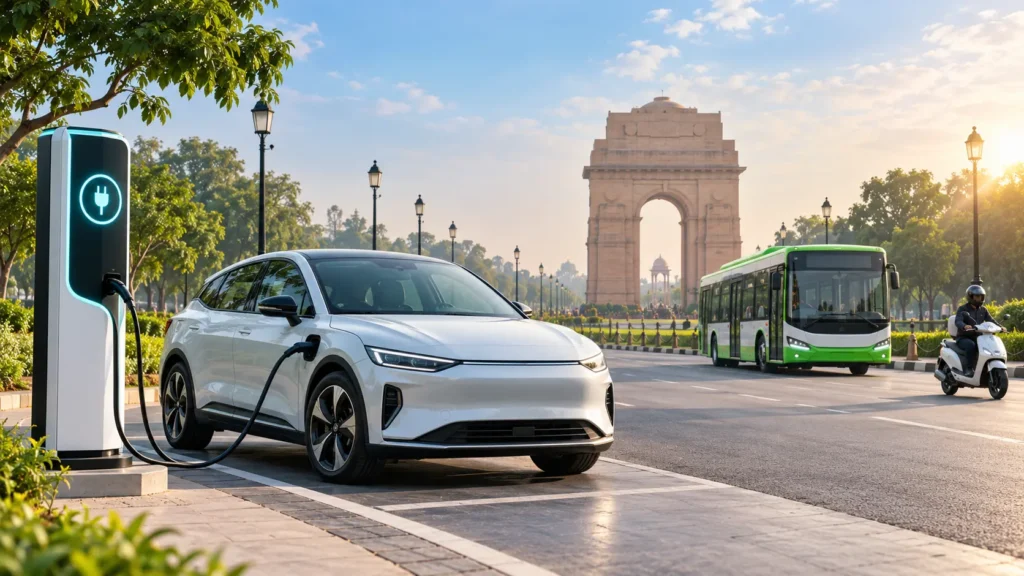
To support this sudden influx of battery powered vehicles, the Government is rushing to roll out 32,000 public Charging points. If they pull it off, it completely rewrites urban mobility.
Strict Deadlines Inside the Delhi EV Policy 2.0
The government is done asking nicely. The most shocking part of this policy is the strict cutoffs for internal combustion engines.
By January 1, 2027, you can forget about registering new petrol or CNG auto-rickshaws and N1 category commercial goods vehicles. They must be electric.
The discipline knocks even harder on April 1, 2028, when the registration of new petrol Two-wheelers gets permanently banned.
A lot of people panicked thinking their current bikes would be illegal overnight. Fortunately, a grandfather clause protects existing vehicles.
Your old petrol scooter can stay on the road until the end of its legal lifespan, but buying a new one simply will not be an option.
Financial Perks Driving the Rs 15000 Crore Plan
Financial incentives are the only way to get people to swallow the higher upfront costs of going electric.
The state is handing out direct purchase subsidies in the first year, offering up to ₹30,000 for electric two-wheelers and ₹50,000 for three-wheelers.
If you have an old BS-IV car, you can grab a ₹1 lakh scrappage bonus when buying a new EV priced under ₹30 lakh.
Pure electric vehicles also get a 100% waiver on road tax and registration fees. But here is the kicker. Strong hybrid cars got completely snubbed.
Despite heavy lobbying from automakers, hybrids get zero subsidies and zero tax waivers. It is pure electric or nothing.
Future Impact of the Delhi EV Policy 2.0 on Buyers
Automakers are essentially being forced to scrap their existing playbooks and change immediately. The mandate gives manufacturers no wiggle room, and consumers are the ones left navigating this forced transition.
The 2028 Two-wheeler ban will completely upend how Middle class commutes. I know the heavy Subsidies soften the blow for early adopters, but those Incentives taper off year by year.
Whether this Investment actually clears the air or just financially squeezes everyday Commuters trying to get to work remains a big gamble.