
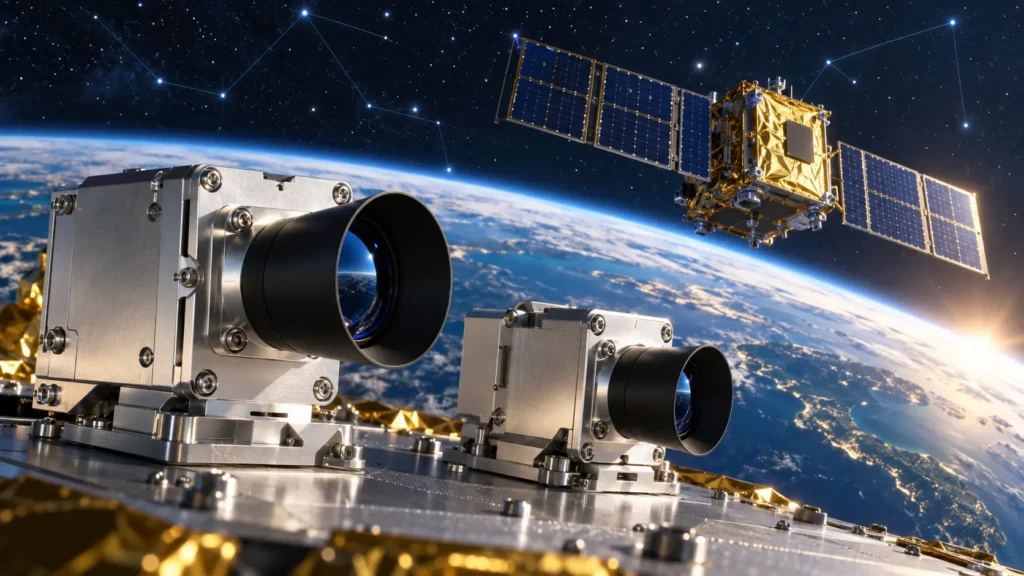

Spacecraft attitude determination has long served as a frustrating obstruction in low Earth orbit operations, forcing engineers to rely on expensive, custom-built hardware just to keep a satellite properly oriented.
This blog dissects a major turning point in orbital engineering, specifically analyzing the recent developments when Terran Orbital launched new star trackers at the SATSHOW 2026 exhibition.
By moving away from bespoke sensor manufacturing, this change signals a concrete change toward scalable navigation hardware capable of meeting the aggressive timelines of modern satellite constellations.
Decoding Terran Orbital Star Trackers Hardware
On March 25, the industry saw exactly what happens when a Lockheed Martin company decides to standardize attitude determination. Terran Orbital revealed three distinct models on the exhibition floor- the M10, H6, and F4.
Each variant directly addresses a specific tier of spacecraft requirements without forcing operators to redesign their entire navigation loop. The core advantage of these sensors lies in their processing architecture.
They utilize highly robust onboard algorithms that execute rapid initial attitude acquisition, stripping away the usual lag times.
From there, the trackers push continuous high-rate quaternion data straight into the Spacecraft’s attitude determination and control systems.
Peter Krauss, the Company’s President and CEO, rooted the announcement in practicality rather than theory.
He affirmed that Operators need ‘mission-proven’ reliability and Modular components, to allow Engineers to build large fleets without second-guessing foundational hardware.
Environmental Testing Regimes Revealed at SATSHOW 2026
Engineering circles rightly demand rigorous methodological proof before adopting new navigation components.
The hardware displayed in Washington D.C. was not a collection of rapid prototypes but rather flight-heritage hardware backed by brutal environmental qualification data.
Terran Orbital subjected these optical units to extreme thermal cycling and aggressive vibration profiles to simulate the physical trauma of launch and deployment.
More importantly, the optical algorithms underwent validation against complex, simulated night sky conditions to ensure they would not lose their fix during high slew rates.
Data from these trials proves the optical sensors maintain a precise lock even when a spacecraft undergoes rapid maneuvering. Such extreme stress testing guarantees the trackers arrive ready for immediate orbital deployment.
Seamless Integration for Next Generation Satellite Missions
Hardware is useless if engineers spend months figuring out how to bolt it onto a bus. Terran Orbital specifically targeted spacecraft architecture compatibility to solve this integration nightmare.
The trackers rely on standardized physical and digital interfaces, turning what used to be a complex engineering challenge into a straightforward plug-and-play operation.
This modularity drastically cuts down lead times for both commercial broadband constellations and defense networks. Beyond physical mounting points, the true flexibility of these systems sits in their software.
The platform supports continuous on-orbit software updates, allowing ground control to refine algorithms or improve tracking accuracy long after the hardware has left the atmosphere.
This capability effectively future-proofs the navigation loop against evolving mission parameters.
Market Trajectory for Terran Orbital Advancements
The broader economic impact of mass-produced Attitude sensors cannot be overstated.
The M10 model ardently targets cost-efficiency at scale, proving Operators no longer have to sacrifice accuracy simply to keep constellation budgets under control.
By leveraging automated manufacturing alongside standardized interfaces, the aerospace sector can now rapidly deploy defense and Earth observation systems.