
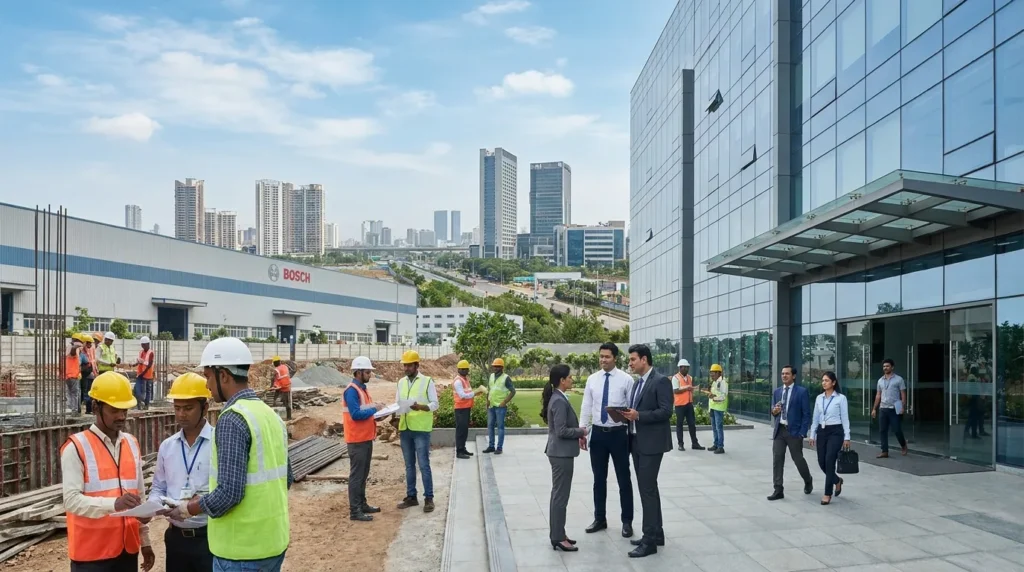

Step off the local train at any industrial suburb in Pune right now, and the noise hits you before the heat does. It’s the heavy, rhythmic thud of stamping presses from newly funded manufacturing facilities.
Politicians love throwing around Billion-dollar figures on television. But if we want to look at actual paychecks instead of press releases, we have to examine exactly how FDI in Maharashtra is boosting local employment from the factory floor up.
The raw 2026 data is staggering. The state secured ₹1.64 lakh crore in 2024-25- a massive 39% of India’s total inflows. Then, in just the first half of 2025-26, it locked down another ₹91,337 crore.
The Davos 2026 FDI Pacts & the Local Employment Reality
Let’s talk about the World Economic Forum in Switzerland this past January. Usually these Summits are just excuses for aristocracy to drink overpriced coffee. Not this time.
The state government actually sat down and inked MoUs worth a ridiculous ₹30 lakh crore with companies from 18 countries. And they aren’t just pouring this cash into glass towers in South Bombay. That is a tired myth.
The real employment change is happening out in Gadchiroli, which is being aggressively transformed into a massive Steel hub, and across the eastern Vidarbha corridor. These new agreements are projected to generate around 40 Lakh jobs. A big structural shift.
Tracing Foreign Direct Investment Impact on Maharashtra Job Markets
You can literally trace the foreign capital hitting the ground through the recently unveiled Maharashtra Industry, Investment and Services Policy-2025.
Running from 2026 to 2030, this policy has a hyper-specific, blunt target of 50 lakh direct jobs. No vague promises. Just raw employment quotas.
Foreign capital is also bleeding into the local startup ecosystem. By early 2026, the state hit tens of thousands of registered startups, organically generating roughly 3.79 lakh jobs. It turns out when you make it easier for global funds to inject seed capital into local ideas, people actually start hiring.
The Trickle Down Effect of Global Capital on Local Workers
Global capital allocation usually looks like a chaotic local street cricket match. To an outsider, it makes zero sense. But everyone on the ground knows exactly where the ball is going.
Maharashtra is aggressively pulling ahead of Gujarat and Karnataka in retained investments largely because they fixed their infrastructure financing with the new Maha InvIT trust.
When a foreign-funded semiconductor or EV plant opens, it spawns a massive, totally unorganized supply chain. We are talking about the transportation guys, the lukewarm vada pav vendors outside the gates, the regional parts suppliers operating out of tin sheds. Academics completely ignore these indirect jobs. I won’t. They pay the rent.
What the Latest Economic Data Means for the Working Class
The foreign capital is already sitting in the bank. The real question moving forward isn’t whether the money will arrive. It’s whether the local skills gap will close fast enough to put rural workers in those newly funded, highly technical seats.
If you are setting up AI-driven supply chains in Nashik, you need people who can run the software. If the state’s massive push to train youth under the new startup and innovation policies fails, all this foreign money will just end up importing talent from other states. The clock is ticking.