
If you look at the large investments pouring into Himachal Pradesh, it becomes obvious that replacing fossil fuels and import-heavy pharmaceutical supply chains is not just a side project anymore. It is a survival strategy.
By fusing Zero-emission transit with heavy Industrial manufacturing under the umbrella of Green Hydrogen Buses and Bulk Drug Park, Himachal Pradesh has placed a high stakes Economic bet.
The state is trying to prove that you can protect a fragile Himalayan ecosystem while simultaneously building major job-generating industries.
Himachal Pradesh Revolutionizing Transit with Hydrogen Buses
Fossil fuel transit in the Mountains is an ecological disaster. The steep Climbs chew through Diesel and spit out black soot into the valleys. Enter the National Hydro Power Corporation and their pilot project in Chamba.
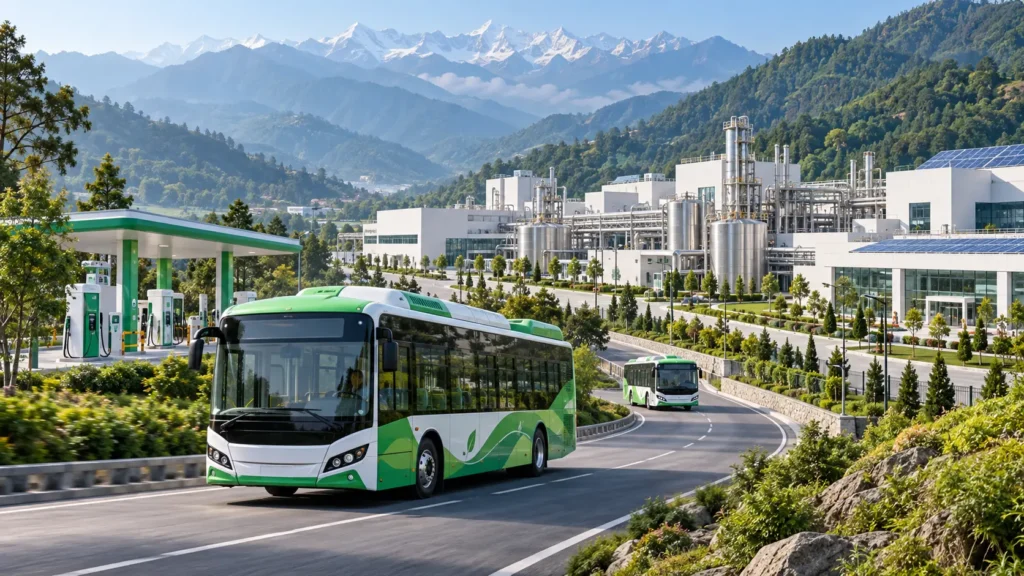
They are throwing Rs 14 crore into a mobility station right next to the Chamera-3 power station. The math here is specific. A 300-kilowatt grid-connected Solar plant will power the electrolysis process to produce 20 kg of hydrogen a day.
Stored at a blistering 450 bar of pressure, this fuel is meant entirely for a new fleet. The local transport authority is under strict orders to modernize, and rolling out these Green Hydrogen Buses is step one in severing the region’s ugly dependence on diesel.
It is an aggressive move. Getting this technology to work efficiently at high altitudes is notoriously difficult, but the government is pushing it through anyway.
Himachal’s Mega Haroli Drug Park Overhaul
We rely entirely too much on China for Active Pharmaceutical Ingredients. It is a dangerous supply chain vulnerability that the central and state governments are finally trying to fix.
The solution taking shape in the Haroli segment of Una district is massive. We are talking about a 1,405-acre industrial footprint backed by a staggering Rs 1,923 crore capital outlay.
By early 2026, the utility infrastructure- specifically the 15 MLD water supply systems and immense power transmission lines- hit their final completion phases despite ongoing friction with local environmental clearances.
Cramming a Bulk Drug Park into a semi-rural zone is bound to cause tension. Villagers are rightly demanding strict zero liquid discharge policies and continuous emission monitoring.
But the economic momentum is too heavy to stop. This facility is designed to host over a hundred industrial units, fundamentally shifting India’s pharmaceutical manufacturing base away from foreign reliance.
Winning the New Himalayan Bet
Job creation and ecological preservation usually sit on opposite ends of a boxing ring. When you bring heavy pharma manufacturing into the mountains, you risk wrecking the very environment you claim to protect. That is why the dual approach here actually makes a twisted sort of sense.
The pharmaceutical expansion in Una is projected to generate roughly 15,000 to 20,000 direct and indirect jobs. To balance that massive industrial carbon footprint, the state is aggressively decarbonizing its transport sector at the exact same time.
The strategy being deployed across Himachal Pradesh is less about pure environmental idealism and more about brutal economic independence.
They are building the capacity to manufacture their own critical medicines while generating their own clean transport fuel. If they manage to pull off this high-wire act by the March deadline, they won’t just meet a climate target. They will own their entire supply chain.