
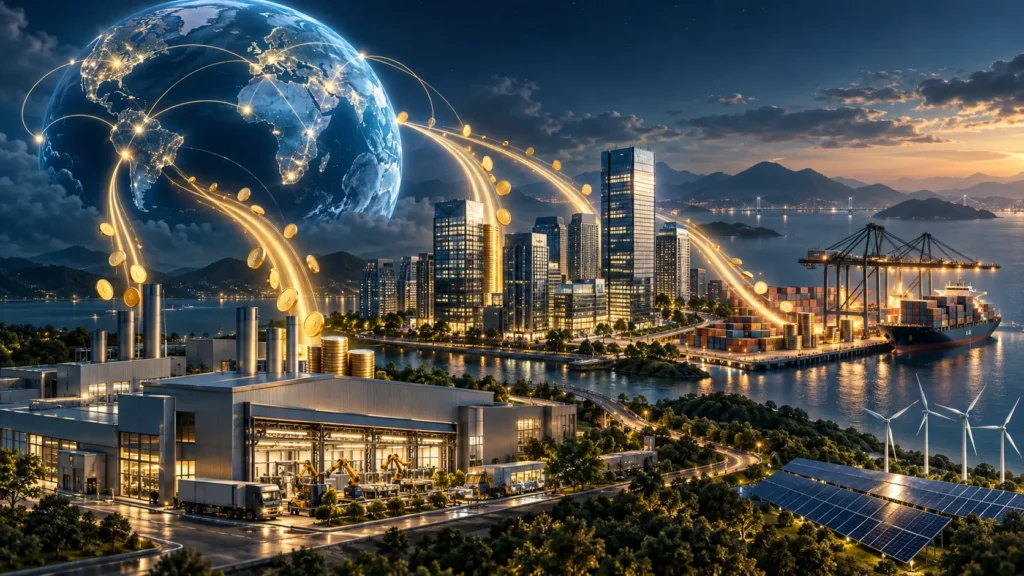

Whenever someone wants the mechanics of cross-border investments and FDI inflows explained, the immediate next question is almost always about where the money actually goes.
It is an honest question. We are looking at global FDI hovering around the $1.6 trillion mark according to early 2026 economic trackers.
But unlike previous decades where capital reliably chased cheap labor to build industrial factories, the current distribution of these funds has radically changed direction.
Global FDI Inflows And The Digital Money Surge
The days of foreign capital strictly funding heavy manufacturing are fading rapidly. Today, international investors are entirely obsessed with the digital economy.
The big change toward technology is undeniable, with hundreds of billions pouring directly into greenfield data centers, cloud infrastructure, and centralized artificial intelligence hubs.
We are seeing major tech conglomerates bypassing traditional industrial regions and dropping astronomical sums into software and IT services instead. This entirely redefines how we track FDI inflows globally.
The physical footprint of this money looks less like smokestacks and more like vast, hyper-cooled server farms running quietly in the suburbs. When evaluating where the bulk of modern FDI ends up, the digital economy is eating the lion’s share of international capital.
Physical supply chains break during geopolitical crises, but data ecosystems scale exponentially without needing a single shipping container.
Emerging Markets Claiming New Money From FDI Inflows
Capital allocation is also changing geographically in a major way. We keep hearing about the Global South capturing a huge slice of these Investments. And the latest 2026 data completely backs this up.
Investors are betting on Emerging markets. India, for instance, just recorded a historic gross surge reaching $94.5 billion in FY26. That is a staggering figure that proves exactly where the smart money is heavily concentrated right now.
You see similar aggressive financial plays landing in places like Brazil and Malaysia, which are quickly becoming heavyweights in hosting regional tech hubs and green energy infrastructure.
Tracking these FDI inflows shows a clear departure from the old Western-centric model. High-growth regions are no longer just passive recipients of outsourced factory labor.
They are actively claiming the new FDI by offering significant scale and increasingly skilled digital workforces that directly support complex global business operations.
Real World FDI Inflows And Smart Money Moves
So what does this actually look like on the ground? The capital does not just sit securely in foreign bank accounts gathering dust.
It translates directly into immediate local job creation, deeply integrated domestic supply chains, and a booming renewable energy sector.
We are talking about tangible, aggressive domestic growth fueled by foreign investments. Real world FDI inflows mean a new solar component facility opening up locally or a tech campus suddenly hiring thousands of software engineers.
The money fundamentally alters the economic gravity of the exact cities it lands in. This is why tracking the actual destination of FDI is so critical to understanding current global power dynamics.
It is a lot less about cheap resource extraction now and significantly more about building self-sustaining global digital ecosystems. Governments are competing fiercely for these funds because landing a major tech or green energy investment completely reshapes their economic trajectory for decades.