
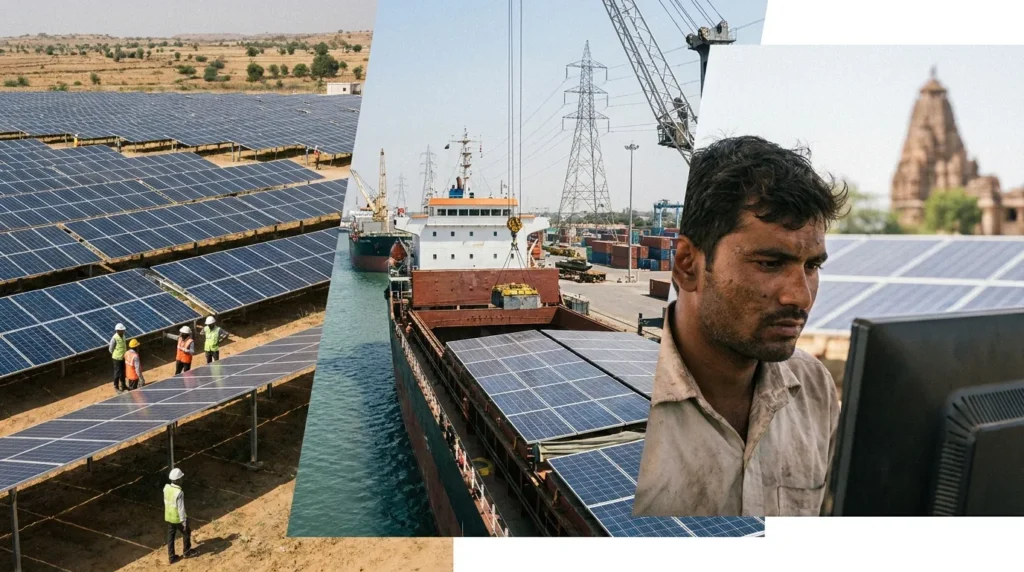

Right now, the South Asian power grid is wiring itself together. Literally. They are dragging high-voltage cables through mud, mountains, and the narrow Siliguri Corridor to keep the lights on across borders.
India has built up an absurd amount of renewable generation capacity, and the obvious next move is finding a way to export this excess electricity. Which brings us to the big question hanging over developers.. Can India Export Solar Power via PPA? The concise answer is yes. But pulling it off requires a solid PPA that actually survives geopolitical spats and currency crashes.
Assessing the Cross Border PPA Framework for India to Export Solar Power
Selling electricity to a foreign country isn’t like shipping crates of mangoes. You need paper. Lots of it. The latest Ministry of Power guidelines explicitly allow Indian generating stations to sell directly to neighboring utilities or through trading licensees like NVVN.
A PPA is the only thing making these capital-heavy solar farms bankable. Without a guaranteed buyer on the other side of the border signing a 25-year contract, lenders will laugh you out of the room.
Just look at the recent trilateral power trade. Nepal managed to export 40 MW of power to Bangladesh right through the Indian grid. India is now aggressively positioning itself to do the same with its own solar output.
Grid Infrastructure Fueling India to Export Solar Power via PPA
Paperwork means absolutely nothing without copper and steel. By late 2025, India was sitting on 10,323 MW of Cross-border transmission capacity connecting the BBIN Subregion.
We are discussing about a big 400 kV high-voltage lines slicing through the terrain. If an Indian developer wants to actually fulfill a cross-border PPA, they have to rely on this physical backbone.
You cannot export thousands of megawatts of solar energy on a whim. You need dedicated green feeders and perfectly synchronized grids.
And frankly, building this infrastructure is brutal. It means fighting for right-of-way clearances, arguing with local municipalities over land, and dragging heavy equipment up unpaved hillsides in the middle of monsoon season.
Regulatory Hurdles in Cross Border PPA Solar Export for India
Here is the ugly truth about international energy trade. It is messy. A developer might have a beautiful PPA signed and sealed, but they still have to beg the Central Electricity Authority’s Designated Authority for export approval.
Then there is the ever-present threat of grid curtailment. If the domestic grid is overloaded or the political winds shift, your solar export gets choked off. Mismatched laws between India and neighboring nations can completely gut a financial model.
Try enforcing a contract dispute in a foreign jurisdiction when your power supply gets arbitrarily cut off by a local bureaucrat. It is a massive, expensive headache that scares off smaller players entirely.
The Future of Cross Border PPA Driven Solar Power Export from India
Look at the upcoming 2030 grid expansion plans. The ambition is completely demented in best way possible. In early 2025, India and Sri Lanka were already pushing an agreement to physically link their electricity Grids via a subsea cable beneath the Palk Strait.
That is exactly the kind of wild infrastructure required to export serious solar energy. Regional dominance will ultimately hinge on a reliable cross-border PPA.
If the contracts hold up in court, the entire subcontinent will run on Indian-generated sunlight. If they don’t, developers will just stop building. It really is that simple.