
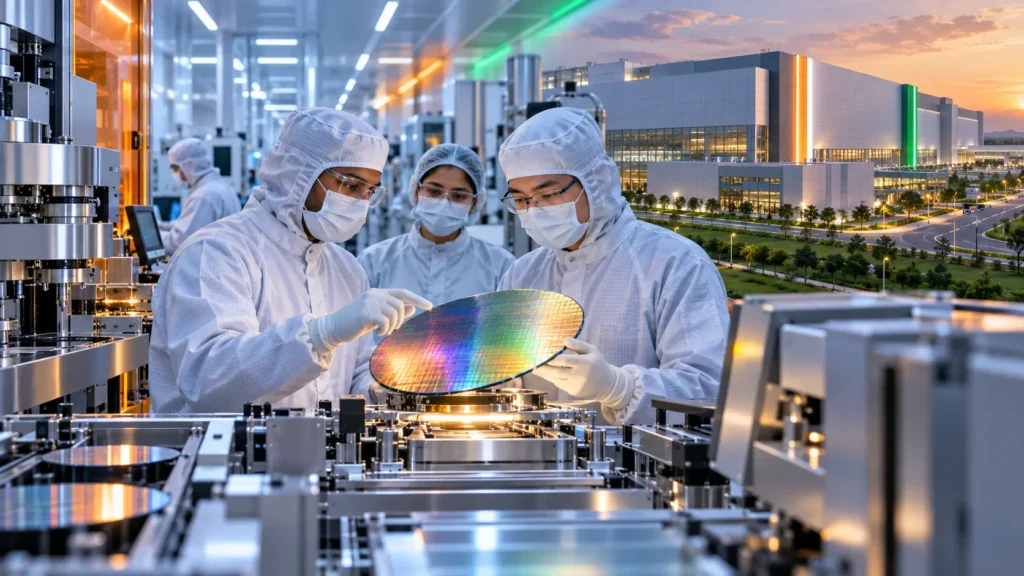

When two big industry players put serious money on the table, it forces global markets to pay attention. We are currently watching a huge change in domestic Semiconductor manufacturing, driven entirely by Foxconn and HCL’s ₹3,700 Cr bet on India’s tech future.
This is not some abstract corporate pledge. It is a calculated move designed to drastically reduce reliance on imported silicon and pull control of critical hardware back inside India.
HCL brings the localized operational muscle, while Foxconn provides the hardcore manufacturing experience necessary to scale an operation of this magnitude.
If you want to understand where the global supply chain is heading, you have to look at what is happening right now in Uttar Pradesh.
The Blueprint Behind the Foxconn and HCL Push for India Tech Dominance
The facts on the ground solidified in February 2026 when the foundation stone was officially laid for “India Chip Private Limited”. This newly minted entity operates as a 60:40 joint venture, with HCL retaining the majority control over Taiwan’s Foxconn.
They are building a giant Outsourced Semiconductor Assembly and Test (OSAT) facility directly in the YEIDA region of Jewar, Uttar Pradesh.
This location is real deliberate, sitting right next to the upcoming Noida International Airport to ensure frictionless logistics. The target operational launch is firmly set for 2028.
This timeline proves they are moving fast to grab market share. The Tech industry does not wait for slow movers, and neither company is interested in wasting time on endless bureaucratic delays. They have the land, the funding, and the regulatory green lights to start pouring concrete.
What a ₹3,700 Cr Investment Means for India Tech Under HCL and Foxconn
You cannot overstate the production math happening inside this facility. A ₹3,700 Cr investment buys you serious scale. The Jewar plant is engineered to process 20,000 wafers every single month.
Foxconn and HCL are not trying to build generic microprocessors; they are aggressively targeting the market for Display Driver Integrated Circuits (DDICs). We are talking about tens of millions of chips hitting the assembly lines.
Beyond the silicon, this translates to over 3,500 direct and indirect jobs. This facility forces the creation of localized supply chains, pulling in gas, chemical, and equipment suppliers who now have a reason to set up shop locally.
India is getting a permanent industrial anchor that actually boosts the regional economy instead of just importing finished goods. For the Tech sector, this is how you build a real foundation.
How Foxconn and HCL Will Secure the India Tech Supply Chain
Every smartphone, laptop, television, and modern vehicle requires display driver chips to function. Right now, heavily importing these components creates a massive vulnerability for hardware manufacturers.
By localizing this exact production node, Foxconn and HCL are solving a critical bottleneck. This Jewar facility essentially becomes a strategic hub for North India, insulating local manufacturers from global shipping crises and geopolitical trade wars.
The India Semiconductor Mission relies entirely on facilities like this actually coming online and hitting their output targets. We are moving past the era of simply assembling foreign components.
Tech independence requires owning the packaging and testing of the silicon itself. That is exactly what this joint venture achieves.