
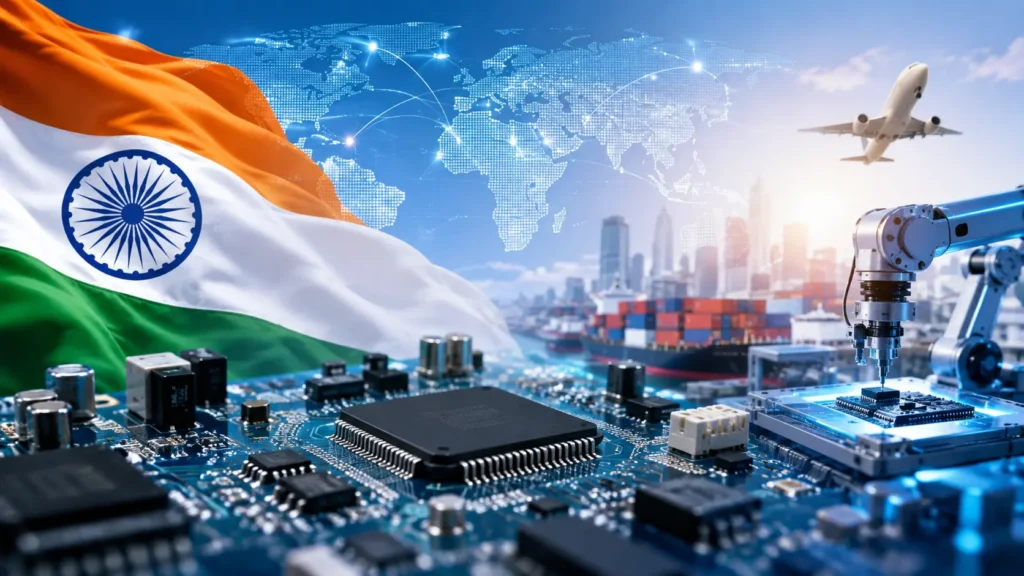

For years, the government bragged about smartphone manufacturing. But if you actually cracked open one of those sleek devices, you’d find a totally hollow victory.
We were just snapping imported Legos together on a factory floor. The bare printed circuit boards, the tiny passive resistors, the heavy lithium-ion cells- all the real, valuable guts of the hardware shipped in directly from overseas.
That is exactly why the ₹22,919 crore Electronics Component Manufacturing Scheme (ECMS) dropped in early 2025 like a financial sledgehammer. It was a massive bet on forcing an entirely new supply chain into existence.
India finally stopped asking for basic assembly plants and started heavily courting foreign capital to build the unglamorous, fundamental raw materials from scratch. This targeted push for FDI growth is a desperate, highly calculated move to own the actual metal and silicon that makes modern hardware run.
Fueling Growth With India’s ₹22,919 Crore Bet
You can’t just wish an Electronics Component ecosystem into reality. You have to subsidize the financial pain of building it from nothing.
The ECMS threw nearly three billion dollars at capital expenditure and turnover-linked incentives to pull domestic value addition up from a miserable 18 percent to a targeted 38 percent. It worked.
The cash acted as a massive, unavoidable magnet for FDI, flooding the administrative pipelines almost instantly. India suddenly found itself dealing with 249 separate applications promising over ₹1.15 lakh crore in investments by early 2026. Which is completely absurd.
They basically put a giant pile of money on the table and watched the global supply chain completely lose its mind trying to grab a piece.
Rewriting Rules For Electronics Component Dominance
But money alone doesn’t clear geopolitical friction. By early 2026, the government realized their massive investment push had hit a brick wall of their own making.
Remember Press Note 3? The strict 2020 rule that feckly banned investments from Border-sharing nations without heavy Government screening? It left around 600 Applications rotting in a bureaucratic purgatory.
So, they quietly rewrote the rulebook. In March 2026, the state allowed up to a 10 percent non-controlling stake for these investing entities and slapped a strict 60-day expedited timeline on approvals specifically for the Electronics Component sector.
They needed the sub-assemblies so badly that they literally walked back a major national security stance just to unclog the FDI bottleneck. It proves exactly how much India is willing to bend its own geopolitical boundaries to get these specific factories built.
The Long Term Payoff For This FDI Growth Strategy
The market response was so violently aggressive that the original budget didn’t even survive a full year. The 2026-27 Union Budget had to brutally expand the scheme’s outlay from the starting ₹22,919 crore up to ₹40,000 crore just to keep pace with the overwhelming demand.
And that is the whole point. This specific influx of FDI isn’t going into flashy consumer brands or software startups.
It is sinking straight into the dirt. It is building massive, hyper-sterile factories that smell of industrial solvents and etched copper, churning out the exact Electronics Component parts the rest of the world is frantically scrambling to secure.
India bet absolutely everything on owning the unglamorous basement of the global hardware market. The money cleared. The concrete is pouring.