
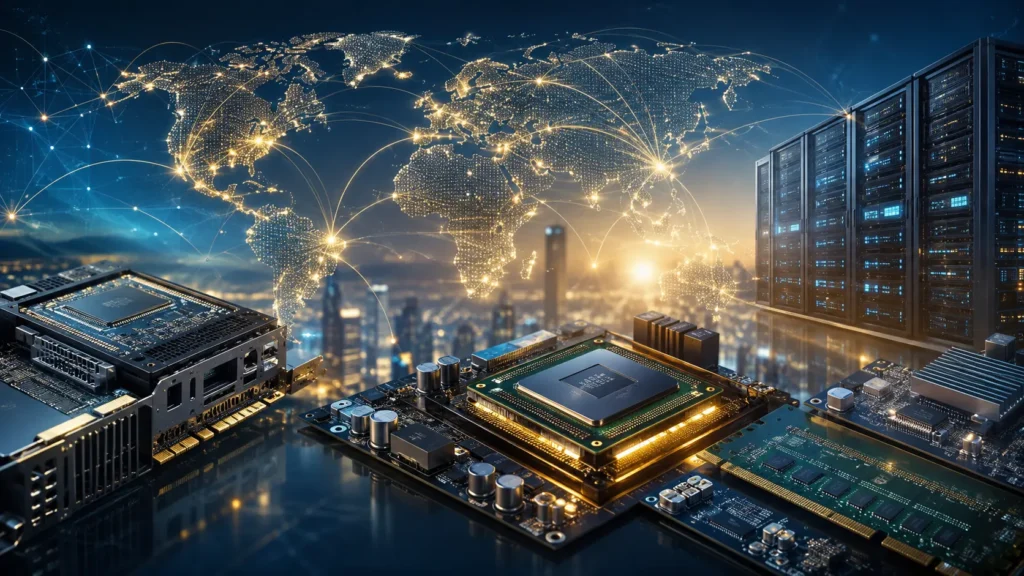

We spent a decade obsessed with floating abstract concepts like cloud software and virtual apps. We completely forgot that “the cloud” is actually just millions of incredibly hot, screamingly loud metal boxes shoved into sterile concrete warehouses.
Now the bill is due. Generative AI broke the internet, and suddenly investors are panicking because you cannot run next-generation models on empty promises. You need raw silicon.
This violent reality check is exactly why the financial world has aggressively pivoted. If you want to know how building physical computer hardware became the hottest new destination for foreign direct investment, here is exactly why.
The AI Boom Made Computer Hardware An FDI Hotspot
The sheer financial weight of the 2026 infrastructure panic is absurd. Top hyperscalers- Amazon, Microsoft, Alphabet, and Meta- are aggressively torching over $700 billion this year alone. They are not buying software startups.
They are buying high-bandwidth memory, heavy liquid-cooling systems, and dense server racks. Building these massive components requires so much upfront cash that it triggers massive foreign direct investment just to break ground.
This influx of offshore capital into physical fabrication plants proves that raw Computer Hardware has finally eclipsed software as the ultimate Hotspot for global FDI. Because right now, whoever controls the heavy metal machinery controls the future.
Supply Chain Paranoia Drives FDI In Computer Hardware
Then you have the geopolitical mess. Nobody wants all their chips trapped behind a single contested border anymore. The lingering scars of previous chip shortages still keep tech executives sweating through their tailored suits. They are terrified.
So they are deliberately splintering their manufacturing footprints, desperate to fund redundant assembly lines in completely new territories.
This deep-seated paranoia forces cross-border money directly into Computer Hardware, turning previously ignored regions into a massive Hotspot for fresh FDI. You simply cannot rely on one single factory when an unexpected tariff or a bad diplomatic tweet could instantly choke your entire supply chain.
Government Subsidies Built A New Computer Hardware Hotspot
This global panic has triggered an aggressive bidding war. Developing nations are practically shoving money into the pockets of tech giants to lure them away from established tech hubs.
Look at India’s $4.36 billion outlay for the Semiconductor Mission 2.0 in the 2026 budget. Tata and ASML just inked an $11 billion deal for a massive wafer fabrication plant in Gujarat. The sharp smell of wet concrete and ozone is replacing the old software parks.
By throwing massive tax breaks at global manufacturers, these governments turned domestic Computer Hardware production into a blazing Hotspot for inbound FDI. It is a calculated bribe. And it is working perfectly.
The Hidden Ceiling For This Computer Hardware FDI Hotspot
But there is a big deeply uncomfortable bottleneck that nobody wants to talk about. You can funnel all the Foreign direct investment in the world into a brand new 2-nanometer fab, but those machines still need electricity. An obscene amount of it.
We are building these sprawling facilities in places where the local power grids already struggle to keep the streetlights on during a mild summer heatwave.
The entire Computer Hardware sector is sprinting toward a brick wall, operating under the delusion that this Hotspot of infinite FDI will somehow magically generate its own water and power. It won’t.
The money isn’t chasing cheap labor anymore. It is going to chase whoever has enough juice left to keep the machines from melting down.