
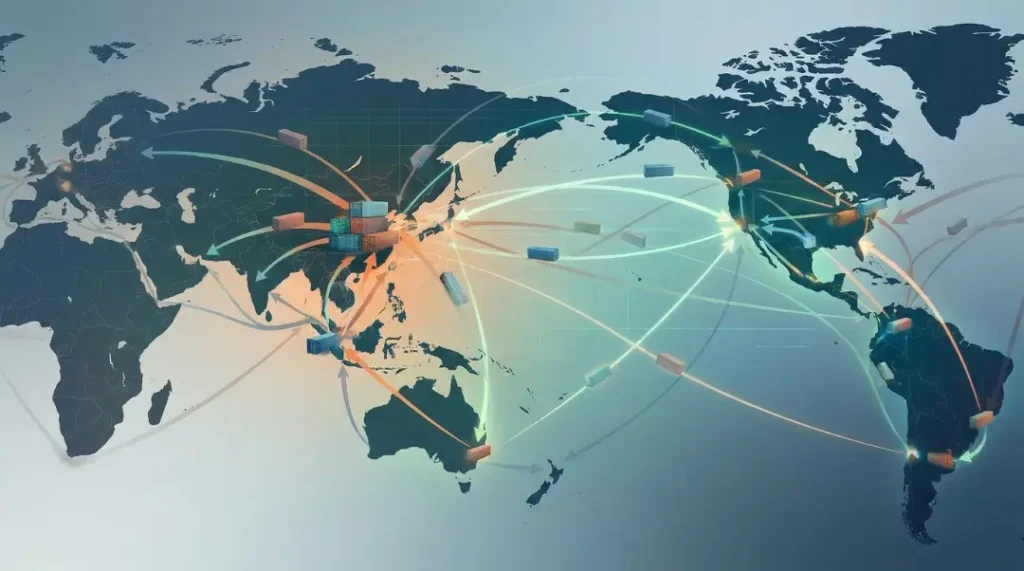

Picture a manager in Ohio staring at a completely stalled assembly line. He is drinking warm instant coffee out of a dented styrofoam cup, and waiting on twelve microchips from a Supplier that just got blacklisted overnight. That is the gritty & panic-inducing reality of 2026 logistics.
If you want supply chain realignment explained, or to genuinely understand how global trade shifted in a few short years, you just have to look at the raw survival reflexes of modern companies.
Put simply, Supply Chain Realignment is the frantic, large-scale uncoupling of businesses from single-source offshore factories, moving production into a scattered web of politically safe countries to avoid sudden disruptions.
The era of obsessing over dirt-cheap, single-source manufacturing is dead. International commerce didn’t shrink. It just fractured into heavily guarded, paranoid regional alliances.
Tracing the Origins of Supply Chain Realignment
Why did corporate executives rip up the hyper-efficient offshoring models of the last twenty years? Because treating shipping networks like a cheap, invisible utility was a massive vulnerability.
Entering 2026, corporations finally conceded that minor reductions in labor expenses did not justify the severe operational risks of a complete facility closure. The whole global trade system was a fragile glass house.
Risk diversification- specifically the “China Plus One” strategy- became the only viable way to keep lines moving. Multi-regional sourcing hit all-time highs this year. Supply chain realignment wasn’t a gentle transition. It was an emergency parachute deployment.
How Friendshoring and Nearshoring Altered Global Trade
We watched the physical movement of factories pivot drastically. Places like Vietnam, India, and Mexico didn’t just absorb the overflow- they morphed into absolute manufacturing heavyweights almost overnight.
There is a stark difference here. Nearshoring is an automaker expanding into Monterrey, Mexico, cutting transit times from 40 days on a rusted cargo ship to a 4-day truck ride.
Friendshoring is about picking hubs based strictly on political alliances to avoid sudden embargoes. These geographical pivots aggressively rewired how global trade operates. You can see the supply chain realignment playing out as shipping lanes literally redraw themselves in real-time.
Protectionist Tariffs Forcing Immediate Supply Chain Realignment
You can’t ignore the belligerent statecraft driving this. Governments weaponized their borders. When the massive April 2025 tariffs dropped, they essentially slapped a lethal tax on old offshore dependencies.
Europe followed right along with its own push for rapid reindustrialization. Companies aren’t restructuring thousands of miles of logistics just to look trendy in boardrooms.
They are bleeding cash. Volatile regulations completely scrambled trillions of dollars in imports, forcing an immediate supply chain realignment across every sector.
The staggering cost of this political fragmentation turned global trade into a brutal game of geographic favorites. You either adapt or go bankrupt.
Sustaining Global Trade Networks Through Automation
Overseeing a fissured, cross-border Supply chain is highly complex & difficult to manage. When you kill the single mega-factory model, you suddenly have a million moving pieces scattered across three different time zones.
You need serious, relentless computing power just to track a pallet of aluminum screws. By mid-2026, artificial intelligence transitioned from experimental tech to an absolute necessity for keeping global trade networks alive.
The sheer complexity of supply chain realignment practically demanded an upgrade in tracking software to survive the chaos. Software doesn’t care about politics. It just calculates the fastest way to route a metal crate before the rules change again.