
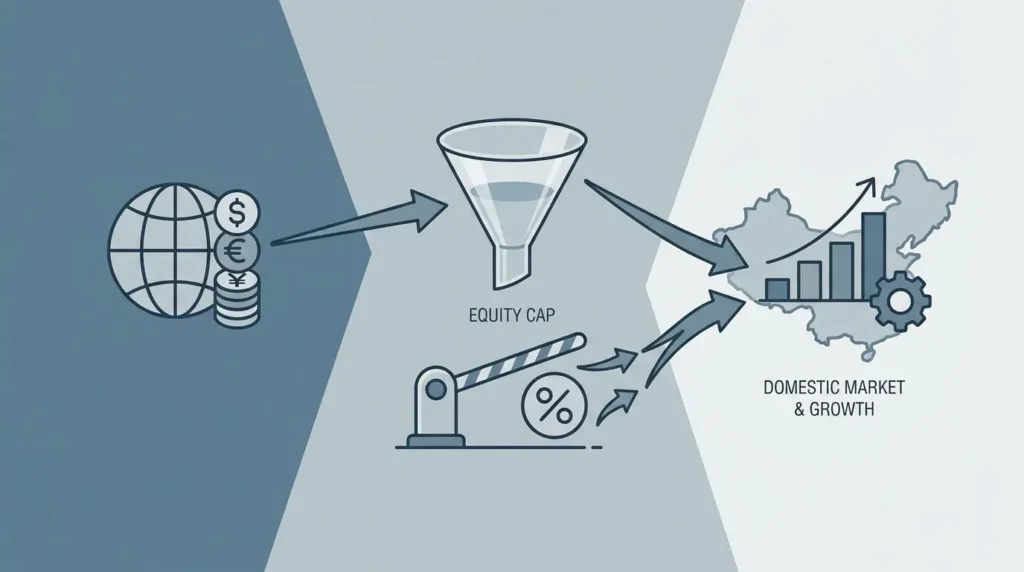

Picture an exhausted regulator in New Delhi aggressively stamping a government circular on a humid May morning in 2026. That single, dull thud of a rubber stamp legally shifts a telecom infrastructure ownership ceiling from 74% to a flat 100%. Instantly, billions of dollars in offshore capital idling in New York holding accounts slam into the local economy.
This is the raw plumbing of global finance. If you want to understand exactly how foreign money flows into a country through equity cap regulations, ignore macroeconomic charts and stare at these invisible ceilings.
Governments use these limits as a thermostat. They desperately crave offshore cash. But they are genuinely terrified of handing the master keys of their sovereign infrastructure to a hedge fund manager in Mayfair.
FDI vs FPI: Understanding the Key Differences and Investment Routes
Forget textbook definitions. Cross-border capital moves in two distinct realities. Foreign Direct Investment happens when a private equity firm buys a physical shipping port in Mumbai or lays literal fiber-optic cables.
Foreign Portfolio Investment is just a London day-trader snapping up fractional shares of an overseas bank. Both hit the exact same sovereign barriers. Under the automatic route, bureaucratic doors are kicked wide open.
The capital lands instantly. But switch to the government route, and defense ministries scrutinize every single cent for months to figure out who actually owns the shell company funding the transaction.
Why Some Sectors Have Foreign Investment Limits
Why exactly would a developing nation reject free cash? Sovereignty. A state will protect its local retail stores from being totally obliterated by multinational giants. Or it will block foreign entities from buying its newspapers to control the domestic narrative.
Look at the Philippine Thirteenth Regular Foreign Investment Negative List, actively enforced in 2026.
They deliberately slapped a strict 40% maximum limit on domestic enterprises building defense materiel. They definitely need the factory funding. They just completely refuse to let a foreign contractor legally own their weapons supply chain.
The math is highly intentional. A 49% limit guarantees local founders still legally win every single screaming match at the boardroom table.
100% FDI Under the Automatic Route: What It Means
Look at the aggressive liberalization happening right now. By early 2026, the Indian government pushed the insurance sector cap to a full 100% under the automatic route. Why? They desperately needed specialized actuarial products and decided to just let global giants take total ownership to force the market to mature.
They did the exact same thing with satellite manufacturing. And then you have Beijing. Chinese regulators went the exact opposite direction.
They shoved advanced node semiconductor manufacturing deep into the restricted category, abruptly blocking a massive two-billion-dollar acquisition of a mainland AI startup by western capital. An obscure rule change in Asia completely wrecks a morning trading desk in London.
Capital basically behaves like water. It always finds a crack in the physical wall. A sovereign regulator drafts a strict 26% limit.
A clever offshore legal team then spends three weeks drafting a convoluted web of holding companies and quasi-debt instruments to completely bypass that exact limit and dump the funds anyway.
Lawmakers will just keep trying to patch those cracks with new arbitrary percentages, entirely blind to the fact that the cash already moved.