
Let’s picture a normal Tuesday morning. You are sitting in a drive-thru line waiting for a lukewarm coffee, aggressively tapping your phone screen to buy twenty shares of a foreign tech company on a trading app. Congratulations. You just acquired equity capital. But you are not exactly a macroeconomic power player.
Now, contrast your morning with a German automaker dropping $2 billion to build an electric vehicle battery plant in a small Maharashtra town. That is Foreign Direct Investment.
People constantly swap these terms around on financial news networks when they actually mean entirely different realities. We are going to look closely at equity capital and FDI to figure out what the real difference is anyway.
Because one is just a passive ownership ticket, while the other literally shifts global supply chains.
What Is Equity Capital and How Does It Work?
Strip away the Wall Street talk. Equity capital is simply a slice of the pie. It is the money a company raises by selling off shares of itself.
When you buy equity, you are buying a piece of ownership. That money goes into the company’s bank account to fund operations, pay off debt, or buy new office chairs. And here is the kicker. Equity capital can be entirely domestic.
You can hand your cousin ten grand for a 5% stake in his pressure-washing business. That is equity capital. You have money in the game, but you don’t necessarily have the power to force him to wake up early and actually wash driveways.
What Is Foreign Direct Investment (FDI) and How Does It Work?
FDI operates on a completely different scale. The global standard is the strict 10% rule. If a foreign entity buys 10% or more of the voting stock in a company, they cross the threshold from a passive investor to an active controller. Boom. It instantly becomes a Foreign Direct Investment.
But FDI isn’t just about buying shares. It is about strenuously crossing borders to set up shop. It includes building new Factories from scratch, buying out local competitors & transferring proprietary technology. It is a calculated, hands-on takeover.
FDI vs Equity Capital: What’s the Difference?
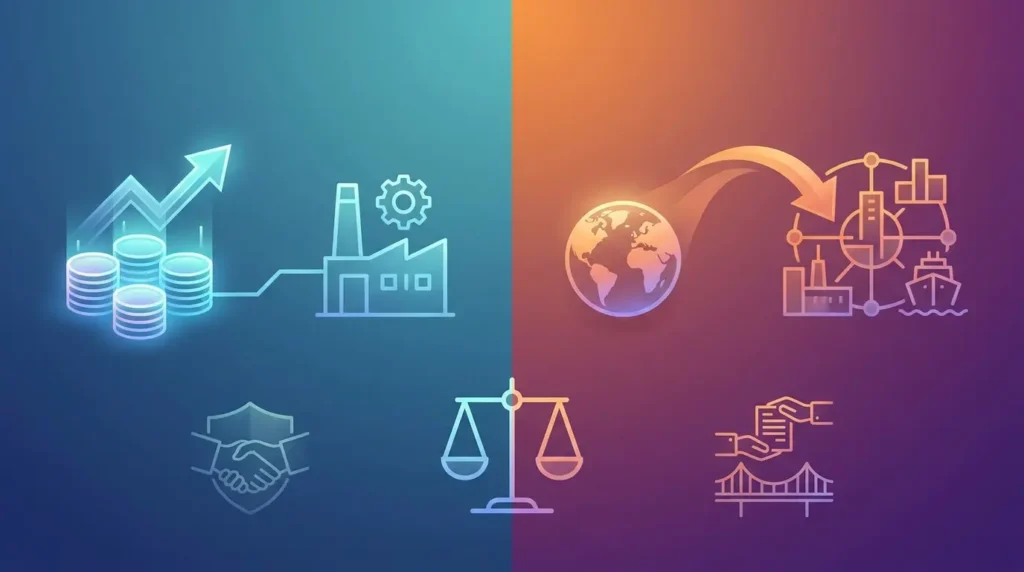
Here is where the massive confusion happens. Equity capital is just one single component of FDI.
Think of it like this. Equity capital is the instrument. FDI is the massive cross-border strategy. When an overseas corporation makes an FDI, they absolutely use equity capital to buy their stake.
But they also use reinvested earnings and intra-company loans. FDI brings management, heavy machinery, and local jobs. Equity capital just brings cash.
Latest Global FDI Trends: Why the Difference Matters
The latest economic data proves exactly why understanding this distinction actually matters. In 2026, global FDI flows are heavily skewed toward massive digital infrastructure. We saw global FDI surge to $1.6 trillion recently, driven heavily by foreign corporations building massive overseas data centers for AI capacity.
They aren’t just funneling raw equity capital into foreign startups anymore. Supply chain reshuffling has forced multinationals to rely heavily on reinvested earnings from their existing overseas branches rather than risking fresh equity capital in unstable markets. They are keeping their money where their foreign factories already are.
Why Foreign Direct Investment (FDI) Matters More Than Equity Investing
If you want to know what a corporation actually plans to do over the next decade, ignore their press releases. Just watch where their physical money goes.
Anyone can buy foreign equity from a smartphone to chase a quick dividend. Setting up a million-Square-foot data center in a Foreign country takes years, massive local hiring & strict Government approvals. Tracking FDI reveals the actual geopolitical chessboard, exposing the quiet moves big corporations make while retail Investors are just busy day-trading shares.