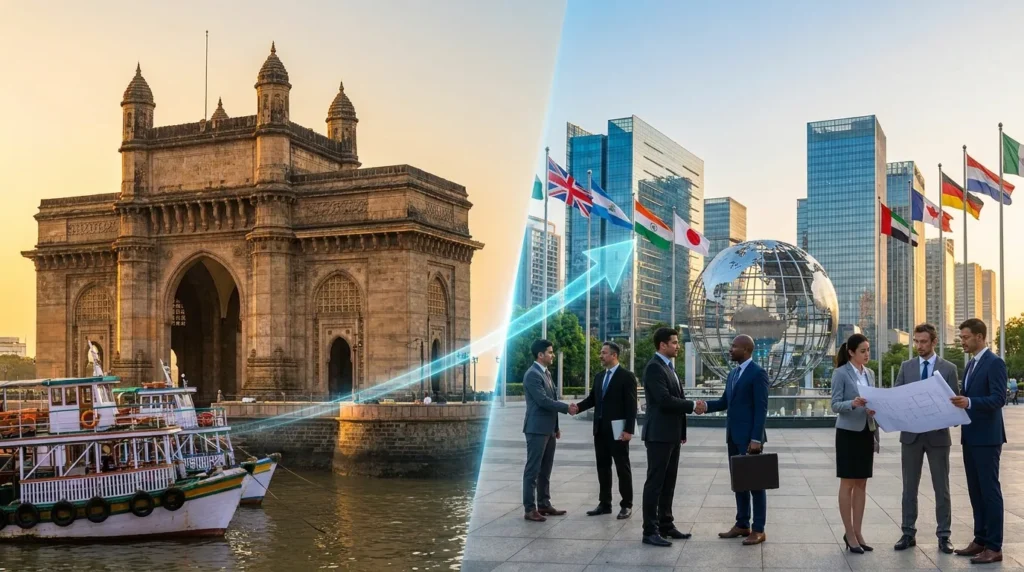

In January 2026, global executives stood freezing in Davos and signed memorandums of understanding worth trillions of rupees with the state government.
But the actual execution of those deals rarely happens in Swiss chalets. It happens in the blistering heat, dust, and diesel exhaust of places like Shendra, Bidkin, and Gadchiroli.
This article breaks down the exact physical networks- specifically the key industrial corridors in Maharashtra currently attracting FDI- that turn massive international handshakes into poured concrete, active assembly lines, and functioning shipping routes.
We are completely bypassing the standard corporate jargon to look at the actual dirt and geography making this happen. The baseline data is remarkable. Maharashtra pulled a ginormous Rs 1.64 lakh crore in foreign capital during the 2024-25 cycle alone. That ate up 39% of the national share.
Foreign Capital at Ground Zero in the DMIC and AURIC
The Delhi-Mumbai Industrial Corridor is no longer just a theoretical concept sitting on a government PDF. It is a functioning, incredibly loud, heavily trafficked grid. The Aurangabad Industrial City (AURIC) attests this outright.
Global bigshots like Toyota Kirloskar, Ather Energy & Lubrizol didn’t just sign ceremonial land agreements over a catered lunch.
They are actively building massive manufacturing plants right now. By late 2025, AURIC crossed Rs 72,000 crore in investment potential across over 320 allotted plots.
Foreign investors actually use these specific “plug-and-play” utility setups to bypass years of local regulatory headaches. They show up, plug straight into the pre-built underground water and power lines, and start pouring foundations.
The Samruddhi Mahamarg Expressway Feeding Maharashtra FDI Inflows
The physical transport math changed practically overnight in September 2025 with the operational ramp-up of the AURIC-Samruddhi Connector. Foreign direct investment relies entirely on predictable exit routes for manufactured goods. Nobody builds a billion-dollar factory if they cannot get the finished product to the ocean.
The massive Mumbai-Nagpur expressway acts as a high-speed conveyor belt dragging heavy freight directly from the interior to the JNPT Port. An approved 2026 extension of this corridor stretching toward the upcoming Vadhvan Port completely alters the logistics game. It perfectly cements western Maharashtra’s absolute dominance in heavy exports.
Vidarbha and the Emerging Steel Corridors Attracting Global Heavyweights
Western Maharashtra gets all the mainstream media hype. The new industrial money, however, is quietly eyeing the eastern districts. The state pushed an aggressive 2026 mandate to transform Gadchiroli and eastern Vidarbha into a dedicated, high-output steel corridor. Foreign investors building heavy manufacturing plants care about one thing above all else.
Minimizing the exact transport cost of raw materials. The newly updated Maharashtra Industry, Investment and Services Policy explicitly incentivizes setting up shop right next to these raw mineral veins. It is a deliberate, highly calculated move to absorb the heavy industry spillover from fully saturated, overpriced markets like Pune.
The Real Reasons These Key Industrial Corridors in Maharashtra Win Bids
Forget the generic talking points about a favorable business environment. The capital flows here because of aggressive land readiness and the MAITRI single-window system automatically clearing red tape for ultra-mega projects. Investors absolutely hate waiting. Maharashtra just hands them cleared land and a permit.
The 2026 export preparedness index ranks the state at the top because the concrete is already dry. The infrastructure is already fully entrenched in the dirt.