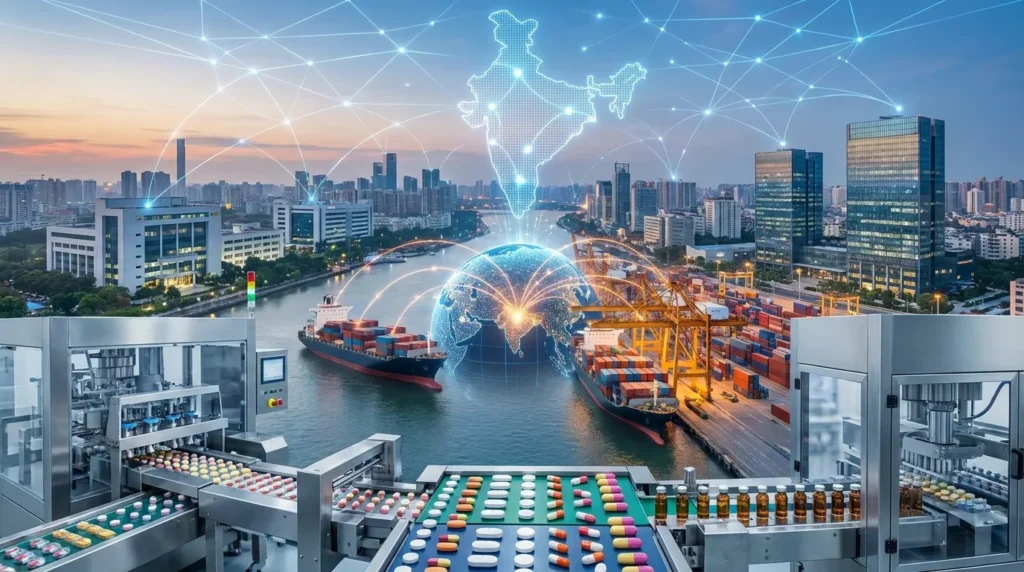

Sixty percent. That is the outright amount of global vaccines supplied into organizations like UNICEF and the WHO right from domestic production lines. When you actually sit down and look at the logistics of this supply chain, it gets terrifyingly massive.
We aren’t just talking about a few sterile factories running overtime in Hyderabad or a couple of warehouses pushing out cough syrup.
We are talking about the mechanical, raw explanation of why India is now the world’s third biggest pharma market.
They supply everyone. If those shipping containers stop moving out of the coastal ports tomorrow, half the world’s generic drug supply simply dries up. The global reliance on this one country is absolute.
The Raw Data Behind India and Its Big Pharma Market
Let’s look at the 2026 numbers because they are incredibly lopsided. The entire pharma sector in India currently sits at a valuation of roughly $60 billion.
They dominate the planet by sheer volume, easily securing that third-place global ranking, but they still stubbornly lag behind at around eleventh place in actual monetary value.
Why?
Because the pharma industry here is completely obsessed with pumping out low-cost generic drugs. They churn out millions of cheap pills instead of owning the expensive, highly profitable patented blockbusters.
Recently, billions of dollars worth of medical shipments went straight out to heavily regulated markets like the US and Europe. It is a volume game. Period.
They make the drugs cheap, they make them fast, and they ship them everywhere. But selling a mountain of ten-cent aspirin doesn’t equal the profits of selling one patented cancer treatment.
Government Schemes Controlling the India Pharma Machine
The state is artificially injecting adrenaline into this system. In February 2026, the government rolled out the Biopharma SHAKTI initiative.
This is not some gentle suggestion for companies to try harder. It is an aggressive Rs. 10,000 crore financial mandate designed to force domestic manufacturing independence over the next five years.
Add that to the ongoing Rs. 15,000 crore Production-Linked Incentive scheme, and you see the real strategy at play. The government is essentially paying the industrial sector in India to stop buying raw materials from overseas and start making active pharma ingredients at home.
They realized during recent supply chain collapses that relying on a single foreign country for base chemicals was a terrible idea. So, they threw billions at the problem to build bulk drug parks from the ground up. It is a brute-force approach to secure supply lines.
How India Will Upgrade This Pharma Market Next
The change from manufacturing cheap generics to actually owning the intellectual property is ugly, expensive, and absolutely necessary.
Domestic drugmakers in India are finally burning cash on artificial intelligence to compress their research timelines. They are tired of just copying existing formulas.
The focus for 2026 is swaying toward complex Biologics and Biosimilars. We are talking about medicines manufactured from Living cells rather than basic Chemical synthesis.
You can’t just throw these together in a standard lab. They require massive upfront investments, highly specialized facilities, and a complete overhaul of how scientists approach clinical trials.
But if they want to move up from being just the volume kings of the global pharma world, they have to own the patents.
The era of merely manufacturing someone else’s invention is ending. Whoever files the most patents in the next five years wins the entire board.