
India’s 2026 economic sprint isn’t some happy accident. It is the result of a big policy overhaul that has finally hit its stride, pushing the nation toward that $10 trillion target.
For any global player eyeing the subcontinent, the first hurdle isn’t the market size- everyone knows that’s massive- it’s the paperwork.
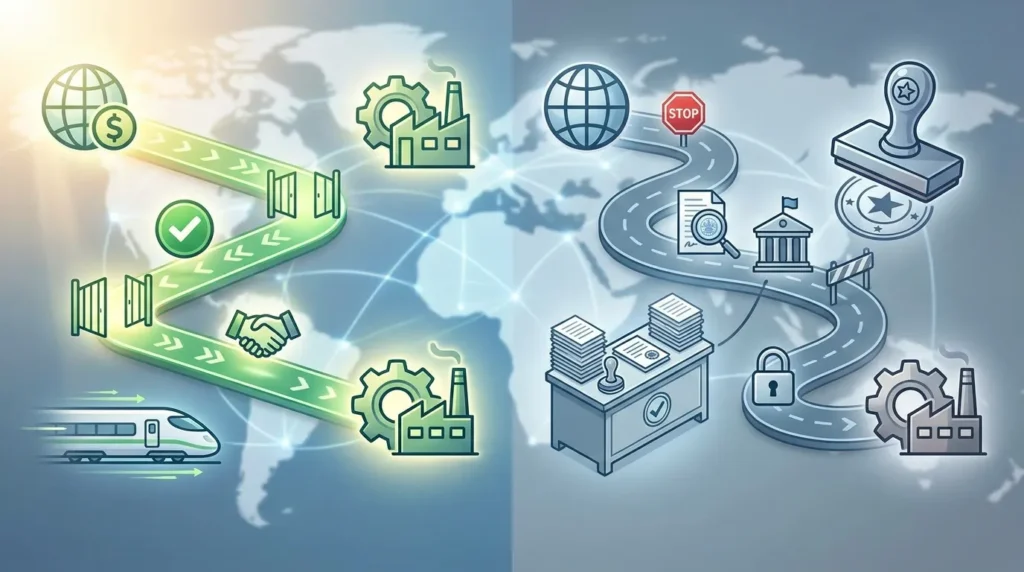
Specifically, knowing the mechanics of how India approves FDI by balancing the speed of the Automatic vs Govt Route is now the difference between a successful launch and a bureaucratic stalemate.
This isn’t just about legal jargon anymore; it is about the pulse of a market that has decided it no longer has time to wait for old-school red tape.
Speed and Scale through the Automatic Route for Global FDI
If you are a tech firm or a renewable energy giant, you likely won’t ever talk to a government official. The Automatic Route is the crown jewel of India’s ease-of-doing-business initiative. In 2026, the list of sectors under this “no-prior-approval” bracket is longer than ever.
Even the Insurance sector, following the recent legislative amendments, now allows 100% foreign equity through this path.
The logic is simple: bring the money, start the work, and tell the Reserve Bank of India (RBI) about it later. The FIRMS portal has replaced the mountains of physical documents that used to plague CFOs.
You have a 30-day window after the funds hit the bank to file your paperwork. It’s a reporting requirement, not a permission hunt. This 2026 framework treats investors like partners rather than suspects, provided they stay within the sectoral caps and pricing guidelines.
Of course, not every door is unlocked. For sectors that India considers “sensitive”- think Defense, Print Media, or Public Sector Banking- the Government Route remains mandatory.
Here, you don’t just file a report; you ask for a seat at the table. You submit your proposal via the Foreign Investment Facilitation Portal (FIFP).
The good news for 2026 is that the days of the “black hole” approval process are gone. Under the National Single Window System (NSWS), every department is now on a clock.
If a ministry doesn’t raise a valid objection within a specific timeframe, the system flags it for immediate escalation. It is still a gatekeeper’s game, especially for Multi-brand Retail where the 51% cap still requires a heavy amount of local sourcing documentation, but at least the rules of the game are now visible on a dashboard.
The March 2026 Breakthrough for Land Border Countries and FDI
Perhaps the biggest shift in the 2026 regulatory environment came from the Cabinet decision on March 10. For years, any investment from a country sharing a land border with India- most notably China- was stuck in a permanent “Government Route” limbo. The new 10% Rule has changed that.
Now, non-controlling investments of up to 10% from these nations can bypass the government’s desk and go through the Automatic Route. The only catch? No board seats and no “influence” over management.
This has provided a massive liquidity injection for India’s electronics and capital goods sectors, which were previously starved for specialized venture capital. It’s a pragmatic middle ground: India gets the cash it needs for its manufacturing boom without compromising on national security.