
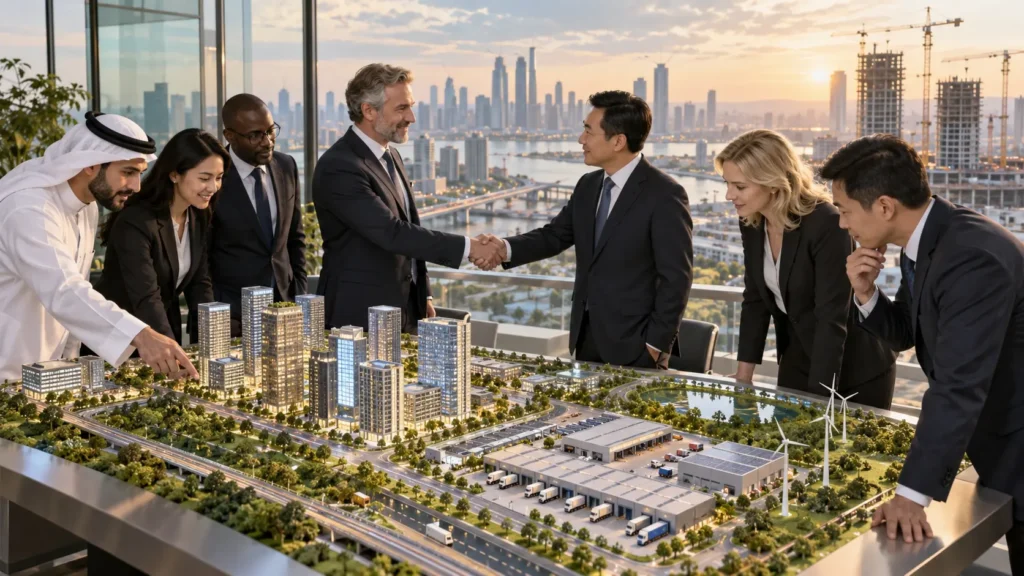

The 2026 global investment situation is very selective. Today, capital is looking for specialized ecosystems. Foreign Direct Investment now concentrates leadenly on high growth sectors like Artificial intelligence Data centers, Semiconductors & low-carbon energy.
For economists trying to decode exactly how local projects attract big foreign investors, the data points to a clear change.
Traditional tax breaks are rarely enough to seal a deal today. Success heavily depends on immediate infrastructure readiness and deeply integrated regional collaboration.
Upgrading Regional Infrastructure to Secure Foreign Investors for Local Projects
Municipalities fighting over corporate headquarters is an outdated strategy. Today, capital flows toward areas operating as cohesive regional hubs rather than isolated cities.
Energy infrastructure and data centers now account for over a fifth of global greenfield investment values. Capturing this wealth requires reliable power grids that cross traditional borders.
When testing new opportunities, Foreign investors look for Plug-and-play transportation networks and robust digital connectivity right out of the gate.
They need high-capacity Water systems and redundant Fiber-optic lines to guarantee zero downtime. If a region cannot immediately support heavy Industrial loads, the money moves elsewhere.
Foundational readiness is exactly what makes local projects viable targets for international capital in a highly competitive market.
Why Foreign Investors Demand Supply Chain Strength in Modern Local Projects
Geopolitical fragmentation has completely rewritten how firms calculate risk. Corporations are actively dismantling vulnerable global supply chains in favor of localized maturity.
Investors funding advanced electronics or renewable manufacturing now demand that the surrounding ecosystem can actually support production without relying heavily on imported components.
Raw materials, skilled technical talent, and regulatory compliance must be deeply integrated within the immediate region. Entities looking to establish secure Manufacturing beachheads are prioritizing regions that offer End-to-end component sourcing.
Foreign investors refuse to tolerate the Supply Shocks that crippled industries a few years ago.
Matching Foreign Investors with Local Projects Through Targeted Policy Support
Bureaucratic friction is a big deterrent to cross-border capital. Governments are adapting by structuring targeted incentives that align perfectly with their national strategic goals.
We are seeing expanded Production Linked Incentive schemes and streamlined approval pathways across major developing markets, alongside the entrenched impacts of domestic manufacturing legislation in the United States.
These frameworks are designed to absorb early-stage entry risks. They provide the financial scaffolding to get industrial sites operational quickly.
Investors no longer have the patience to navigate fragmented local zoning laws or contradictory environmental regulations. When government policy actively removes administrative roadblocks, foreign investors feel confident committing billions.
These aggressive state-backed guarantees act as the final catalyst to get ambitious local projects fully funded.
Sustaining the Momentum of Foreign Investors Funding Ambitious Local Projects
Getting capital in the door is just the first phase of regional economic development. Keeping it anchored requires a continuous pipeline of specialized talent and highly predictable legal frameworks.
International corporations will only stay if the underlying ecosystem keeps evolving alongside their technological needs. Routine infrastructure updates & ongoing academic Partnerships are mandatory to prevent stagnation.
A stagnant workforce or unpredictable regulatory changes can easily trigger Capital flight, even after large initial investments.
Foreign investors need to see long-term commitment from municipal leaders before expanding their initial footprint.