
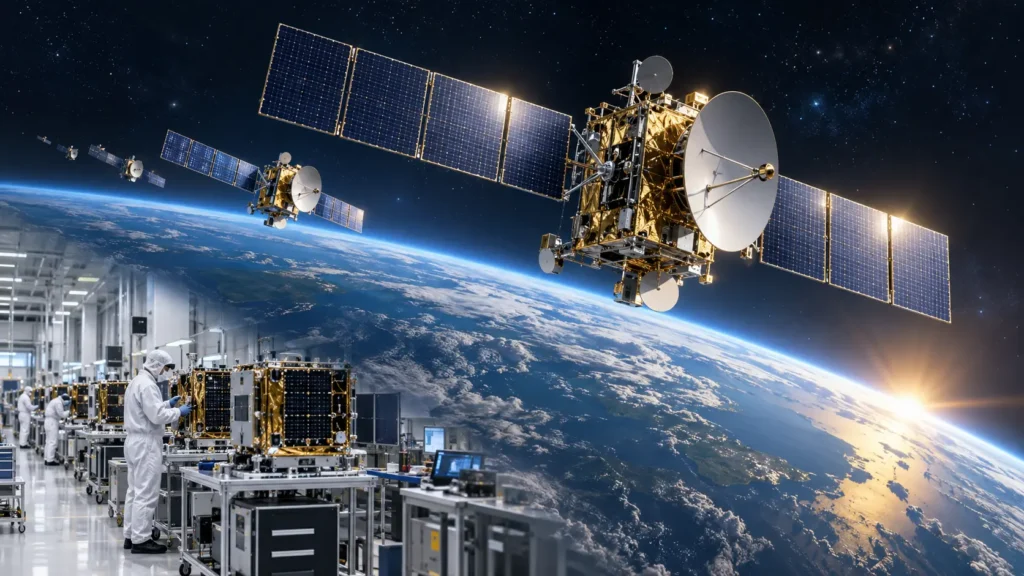

The aerospace sector is no longer a slow-moving government monopoly. Over the past few years, Satellite makers have drastically transformed their manufacturing floors toward high-volume commercial production.
We are actively watching a foundational market of 22 billion dollars expand into an 86 billion dollar industrial powerhouse. This immense financial vault relies almost entirely on the sudden explosion of low-Earth orbit mega-constellations.
Single, bus-sized custom builds are becoming relics. Instead, assembly lines are churning out thousands of compact units to satisfy the immediate global demand for ubiquitous connectivity and real-time Earth observation data.
Why Satellite Makers Are Chasing That $86B Growth
The sheer influx of private capital in 2026 has completely rewritten the aerospace playbook. Global appetite for low-latency broadband and continuous geographic monitoring forces legacy and new space companies to operate at an unprecedented scale.
We are observing a hard switch away from isolated defense contracts that historically took decades to fulfill. Today, the assembly line dictates market dominance.
For large Satellite Makers like SpaceX and Amazon’s Project Kuiper, survival means adopting automotive-style mass production techniques to push fleets into orbit rapidly.
This accelerated production cycle is precisely the catalyst fueling the big growth we are currently seeing across the commercial space sector.
Mid-tier competitors like York Space Systems and Terran Orbital are no longer building isolated science experiments. They are aggressively manufacturing operational infrastructure that generates immediate, recurring data revenue for defense and commercial buyers alike.
The Core Tech Pushing The $22B Baseline Upward
Engineering realities on the factory floor look entirely different today than they did five years ago. Miniaturization and modular architecture dictate the modern assembly process.
Heavy, expensive shielding has been replaced by commercial off-the-shelf components designed for shorter, highly active orbital lifespans.
Engineers at aerospace giants like Airbus and Lockheed Martin are actively integrating artificial intelligence directly into the manufacturing testing phases to slash quality assurance bottlenecks.
Because of these rapid diagnostic tools, agile Satellite Makers can deploy entire modular constellations in the time it used to take to finalize a single blueprint.
Slashing these production cycles directly reduces overhead and drastically lowers the barrier to entry. This engineering efficiency is the exact mechanical foundation responsible for the projected Growth in the decade ahead.
Standardized bus designs allow factories to scale up output without scaling up structural costs.
How Satellite Makers Will Sustain Future Growth
The longevity of this industrial boom relies entirely on maintaining persistent commercial networks. Relying strictly on isolated government defense budgets is a dead business model.
Current revenue streams are directly tied to the continuous replenishment of low-Earth orbit networks, as these modular units naturally degrade and burn up in the atmosphere every few years.
This planned obsolescence guarantees a permanent demand curve. Top-tier Satellite Makers like Northrop Grumman and the newly merged European space entities are locking in multi-year service contracts rather than one-off hardware sales, ensuring their assembly lines never sit idle.
The structural transition into continuous high-volume manufacturing is permanent. This hardware replenishment cycle locks in long-term financial Growth and stabilizes the entire supply chain against market volatility.
The sector has fundamentally matured from a boutique engineering discipline into a ruthless, highly capitalized manufacturing pipeline.